Countertop DishwashersGuide
Is a Countertop Dishwasher Worth Buying? Honest Guide
A countertop dishwasher is worth it for renters, small households, or anyone lacking built-in space. It handles daily dishes but not large pots. Expect 4 to 6 place settings per load. Water use is lower than hand washing. Installation requires a faucet adapter. Check your counter height and outlet access first.
5 min read
A countertop dishwasher is worth it for renters, small households, or anyone lacking built-in space. It handles daily dishes but not large pots. Expect 4 to 6 place settings per load. Water use is lower than hand washing. Installation requires a faucet adapter. Check your counter height and outlet access first.
- Countertop dishwashers save water and time for small households.
- Check capacity, faucet compatibility, and counter space before buying.
- They are not a replacement for full-size dishwashers for large families.
What Is a Countertop Dishwasher?
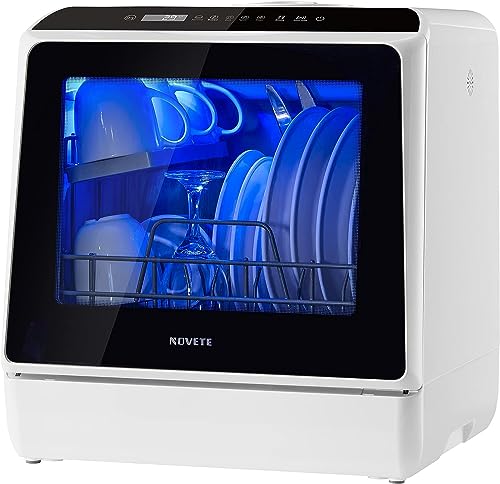
A countertop dishwasher sits on your kitchen counter and connects to your faucet. It is compact, typically 17 to 22 inches wide. Most models hold 4 to 6 place settings. You load it like a standard dishwasher but with less capacity. It drains through a hose into your sink. Some units are portable and can be moved or stored when not in use.
How Much Capacity Does a Countertop Dishwasher Have?
Capacity varies by model, but most handle 4 to 6 place settings. That covers daily dishes for one or two people. You can fit plates, bowls, cups, and silverware. Large pots, baking sheets, and tall glasses usually do not fit. Some models include a fold-down cup shelf for smaller items. Check the interior dimensions before buying, not just the place-setting count.
What Are the Installation Requirements?
You need a standard kitchen faucet with a threaded aerator. Most units come with adapters for common faucet types. The dishwasher connects via a hose that attaches to the faucet. You also need a nearby power outlet, typically a standard 120V. Counter height matters because the unit is about 17 to 18 inches tall. Ensure your counter can support the weight, especially when full of water.
How Much Water and Energy Do They Use?
Countertop dishwashers use about 2 to 3 gallons per cycle. Hand washing the same load can use 8 to 27 gallons. Energy use is low, around 0.5 to 0.7 kWh per cycle. Most models have a heated dry option that adds energy. Some have an eco mode that reduces water and energy. Over a year, savings on water and energy can offset the purchase price.
Who Should Buy a Countertop Dishwasher?
Renters benefit because installation is non-permanent and removable. Singles or couples with small daily dish loads find them practical. Small kitchens with no built-in dishwasher space are ideal. People who cook large meals may find capacity limiting. If you entertain often or have a family, a full-size unit is better. Owners report that daily use reduces hand washing time significantly.
Common questions
Can a countertop dishwasher clean pots and pans?
Most countertop models cannot fit large pots or baking sheets. Small saucepans and lids may fit if placed at an angle. Check the interior height and width before buying. Heavy grease may require pre-rinsing. Some models have a heavy cycle, but capacity remains the limit.
Is a countertop dishwasher better than hand washing?
It uses less water and sanitizes at higher temperatures. Hand washing uses more water and may not kill all bacteria. A countertop dishwasher saves time and effort for daily dishes. However, you must pre-rinse heavily soiled items. For small loads, it is more efficient than hand washing.
How long does a countertop dishwasher cycle take?
Standard cycles run 60 to 90 minutes. Quick cycles can finish in 30 to 40 minutes. Heavy cycles may take up to 2 hours. The heated dry adds extra time. Check the cycle options on the model you choose.
Can I use a countertop dishwasher in an apartment?
Yes, if you have a faucet that accepts an adapter and a power outlet. Most apartments have standard faucets. You do not need permanent installation. You can disconnect and store it when not in use. Check with your landlord if you have restrictions on appliances.
What is the difference between a countertop and portable dishwasher?
A countertop dishwasher sits on the counter and connects to the faucet. A portable dishwasher is on wheels and stands on the floor. Portable units have larger capacity, often 8 place settings. Countertop models are more compact and easier to store. Portable units require more floor space but handle bigger loads.
Do countertop dishwashers need special detergent?
Use regular dishwasher detergent, either powder, gel, or pods. Some models require a specific type, so check the manual. Avoid using hand dish soap, as it creates excess suds. Many users prefer pods for convenience. Rinse aid can improve drying performance.
Are countertop dishwashers noisy?
Most operate around 45 to 55 decibels, similar to a conversation. Some models are quieter than others. Check the noise rating if you have an open kitchen. Running it at night may disturb light sleepers. Placing a mat underneath can reduce vibration noise.
How long do countertop dishwashers last?
Typical lifespan is 5 to 10 years with proper maintenance. Clean the filter regularly to prevent clogs. Descale the unit every few months if you have hard water. Replace hoses if they show cracks. Owners report that cheaper models may last fewer years.