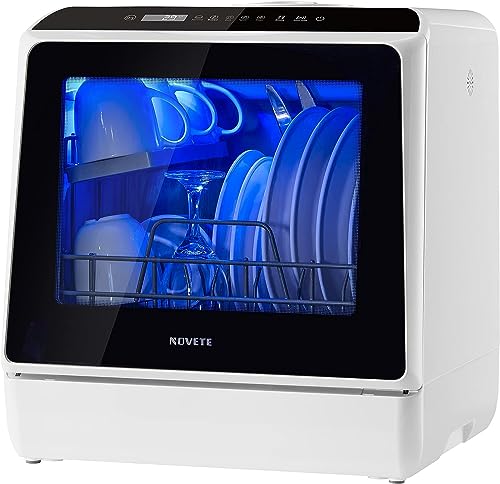
A countertop dishwasher connects to your kitchen faucet and drains into the sink. It fills with hot water, sprays it through rotating arms, and pumps dirty water out. Most models handle a few place settings. They work well for small kitchens, RVs, or apartments without built-in dishwashers.
- Countertop dishwashers connect to a standard faucet and drain into the sink, making them easy to install.
- They use 2 to 4 gallons of water per cycle, less than hand washing, but they consume more electricity.
- Choose vented models for quick cycles or ventless for less steam in small kitchens.
How Does a Countertop Dishwasher Connect to Water and Drain?
A countertop dishwasher uses a quick-connect adapter that attaches to your standard kitchen faucet. The adapter splits the water flow, letting you run the dishwasher or use the faucet normally. A drain hose clips onto the sink edge to carry wastewater away. Most models need a faucet with a threaded aerator. Some newer models can be hardwired to a water line, but that requires professional installation. According to the listing, the adapter fits most standard faucets, but check your thread size before buying.
What Happens Inside a Countertop Dishwasher During a Cycle?
The cycle starts by filling the tub with hot water from your tap. A heating element inside the tub heats the water to around 130 to 160 degrees Fahrenheit for better cleaning. Then a pump pushes water through rotating spray arms that blast dishes from multiple angles. Detergent releases at the right time, and the wash water drains after a few minutes. A rinse cycle follows with fresh water, sometimes with a rinse aid. Finally, a drying fan or residual heat dries the dishes, depending on the model.
Vented vs Ventless Countertop Dishwashers: What's the Difference?
Vented models release steam through a small vent on the top or side. They are simpler and often cheaper, but they can add humidity to your kitchen. Ventless models use a condensation drying system that pulls moisture to a cold panel inside. This keeps steam inside and is better for small, closed spaces. Owners report that ventless models dry dishes more evenly but take longer. Based on specifications, ventless units also use slightly more electricity. Choose vented for quick cycles, ventless for minimal steam.
How Much Water and Energy Does a Countertop Dishwasher Use?
A countertop dishwasher uses about 2 to 4 gallons of water per cycle. That is significantly less than washing dishes by hand, which can use up to 20 gallons. Energy use varies, but most models draw around 700 to 1500 watts during the heating phase. Because they heat water internally, they use more electricity than a full-size dishwasher. However, they are still efficient for small loads. Look for models with an Energy Star rating if efficiency matters to you.
What Can You Wash in a Countertop Dishwasher, and What Should You Avoid?
You can wash plates, bowls, glasses, mugs, and small pots in a countertop dishwasher. Most models have a capacity of 4 to 6 place settings, so load dishes upright and avoid overlapping. Do not wash wooden items, cast iron, or delicate crystal, as the heat and detergent can damage them. Large baking sheets and tall items rarely fit. Check the manual for a list of approved items. Owners report that plastic items sometimes warp if placed on the bottom rack.