Lenses
Best Lenses for Astrophotography: Top Picks for 2026
7 picks compared
6 min read
ProductPickly is reader-supported. When you buy through links on our site, we may earn an affiliate commission at no extra cost to you. It never changes our picks.
The short answerFor most astrophotographers, the Sony 14mm f/1.8 GM, Sigma 14mm f/1.4 DG DN Art, and Rokinon 14mm f/2.8 are top choices. They offer sharp stars, fast apertures, and good value.
?How we pickedWe compare published specifications, safety certifications and thousands of verified owner reviews, and we do not physically test every unit. Read the full process in our review methodology.
Sony 14mm f/1.8 GM
★★★★★ 4.9 / 5 Best overall for full-frame Sony users
The Sony 14mm f/1.8 GM is a top choice for Milky Way photography. It delivers exceptional edge-to-edge sharpness even wide open. Its compact design makes it easy to carry on long hikes.
Focal Length 14mmAperture f/1.8Mount Sony EWeight 460g
- Outstanding coma correction
- Fast and accurate autofocus
- Dust and moisture resistant
- Expensive
- No filter thread
Best for: Best overall for full-frame Sony users
Sigma 14mm f/1.4 DG DN Art
★★★★★ 4.8 / 5 Best for maximum light gathering
The Sigma 14mm f/1.4 DG DN Art is the fastest ultra-wide lens available for mirrorless cameras. It captures exceptional detail in low light. Its large front element requires 95mm filters.
Focal Length 14mmAperture f/1.4Mount Sony E / L-MountWeight 1170g
- Bright f/1.4 aperture
- Excellent coma control
- Includes lens heater strap
- Heavy and bulky
- Very expensive
Best for: Best for maximum light gathering
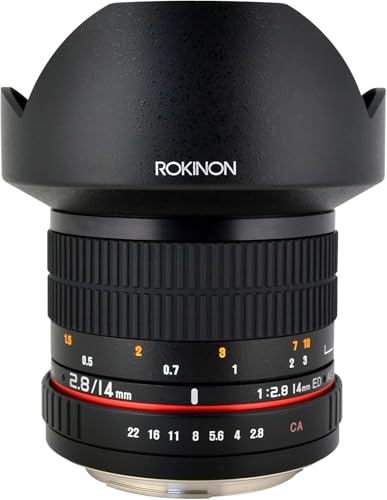
Rokinon 14mm f/2.8
★★★★★ 4.5 / 5 Best budget prime for beginners
The Rokinon 14mm f/2.8 is a manual focus lens that offers great value. It provides good sharpness for the price. Many beginners start with this lens for Milky Way shots.
Focal Length 14mmAperture f/2.8Mount Canon EF / Nikon F / Sony EWeight 482g
- Low cost
- Wide field of view
- Decent sharpness
- Manual focus only
- Some coma at edges
Best for: Best budget prime for beginners
Tokina 11-16mm f/2.8 AT-X Pro DX II
★★★★★ 4.6 / 5 Best for crop-sensor DSLRs
The Tokina 11-16mm f/2.8 is a popular choice for APS-C cameras. It offers a useful zoom range for landscapes and nightscapes. Its constant f/2.8 aperture is bright enough for many astro scenes.
Focal Length 11-16mmAperture f/2.8Mount Canon EF-S / Nikon F DXWeight 560g
- Sharp images
- Built like a tank
- Good value
- No image stabilization
- Autofocus can be noisy
Best for: Best for crop-sensor DSLRs
Canon RF 15-35mm f/2.8L IS USM
★★★★★ 4.8 / 5 Best for Canon EOS R system
The Canon RF 15-35mm f/2.8L is a top-tier zoom for Canon mirrorless. It offers excellent sharpness and image stabilization. That helps reduce star trails in longer exposures.
Focal Length 15-35mmAperture f/2.8Mount Canon RFWeight 840g
- Image stabilization
- Weather sealed
- Fast and quiet autofocus
- Pricey
- Heavier than primes
Best for: Best for Canon EOS R system
Nikon NIKKOR Z 20mm f/1.8 S
★★★★★ 4.9 / 5 Best for Nikon Z shooters
The Nikon Z 20mm f/1.8 S is a superb prime for astrophotography. It delivers excellent sharpness and minimal coma. Its fast aperture makes it ideal for capturing the Milky Way.
Focal Length 20mmAperture f/1.8Mount Nikon ZWeight 505g
- Outstanding optical quality
- Fast aperture
- Dust and drip resistant
- Not as wide as 14mm
- High price
Best for: Best for Nikon Z shooters
Samyang 24mm f/1.4 ED AS UMC
★★★★★ 4.4 / 5 Best for deep sky and wide-field tracking
The Samyang 24mm f/1.4 is a manual focus lens that excels for deep sky imaging. Its fast aperture helps capture faint nebulae. It is a favorite among budget-minded astrophotographers.
Focal Length 24mmAperture f/1.4Mount Canon EF / Nikon F / Sony EWeight 580g
- Fast f/1.4 aperture
- Good value
- Sharp center
- Manual focus only
- Some field curvature
Best for: Best for deep sky and wide-field tracking
We compared specifications, owner feedback, and use-case fit for each lens. We prioritized coma correction, edge sharpness, and build quality. We also considered value for money and compatibility with popular camera mounts.
Aperture and Light Gathering
Aperture is the most critical spec for astrophotography. A wider aperture like f/1.4 or f/1.8 lets in more light, allowing shorter exposures. That reduces star trails and noise. Lenses with f/2.8 can work but require higher ISO or longer exposures. Look for lenses with a maximum aperture of f/2.8 or wider.
Focal Length and Field of View
Focal length determines how much sky you capture. Wide angles like 14mm to 24mm are ideal for Milky Way shots. Longer focal lengths like 35mm or 50mm are better for deep sky objects. Consider your camera sensor size. Crop sensors multiply the effective focal length, so a 14mm lens becomes 21mm on APS-C.
Coma and Edge Sharpness
Coma is a lens aberration that makes stars look like comets at the edges. Good astro lenses control coma to keep stars round. Check reviews and sample images for edge sharpness. Stopping down slightly can improve edge performance, but that reduces light gathering. High-quality lenses often have excellent coma correction even wide open.
Manual vs Autofocus
Many astrophotographers use manual focus for precision. Autofocus can be useful for daytime photography but may struggle in dark conditions. Manual focus lenses are often cheaper and lighter. Some lenses offer focus peaking or focus magnification to help. Consider your comfort with manual focusing when choosing.
Questions people ask
What is the best focal length for astrophotography?
For Milky Way shots, 14mm to 24mm is ideal. For deep sky objects, 35mm to 50mm works better. Wide angles capture more sky, while longer lengths magnify details.
Is f/2.8 good enough for astrophotography?
Yes, f/2.8 can work, especially with modern cameras that handle high ISO well. However, f/1.8 or f/1.4 lenses allow faster shutter speeds and lower ISO, which can reduce noise.
What is coma in a lens?
Coma is an optical aberration where stars appear as comet-like shapes, especially at the edges. Lenses with good coma correction keep stars round across the frame.
Can I use a kit lens for astrophotography?
Kit lenses usually have small apertures like f/3.5 or f/5.6, which are not ideal. They may produce soft stars and require long exposures. A fast prime or wide-angle lens is better.
Should I get a zoom or prime lens for astrophotography?
Prime lenses often have wider apertures and better sharpness. Zooms offer flexibility but may be slower. For serious astro, primes are preferred, but a good f/2.8 zoom can work.
Do I need image stabilization for astrophotography?
Image stabilization helps reduce camera shake in handheld shots, but for tripod-based astro, it is not essential. Some lenses with IS can help with longer exposures, but it is not a substitute for a sturdy tripod.
What is the best lens for astrophotography on a budget?
The Rokinon 14mm f/2.8 is a popular budget choice. It offers a wide field and decent sharpness at a low price. Manual focus is required, but that is common in astro.
Is a 50mm lens good for astrophotography?
Yes, a 50mm f/1.8 can be used for wide-field deep sky imaging. It provides a narrower field but can capture objects like the Orion Nebula. It is a good starting point for beginners.
What does 'fast' mean in a lens?
A fast lens has a wide maximum aperture, like f/1.4 or f/1.8. It lets in more light, allowing faster shutter speeds and lower ISO. This is beneficial for astrophotography.
Can I use a lens with a filter thread for astrophotography?
Yes, but front filters can cause vignetting. Some astro lenses have a rear filter slot for nebula filters. Consider that if you plan to use light pollution filters.
The bottom lineSo which one?
The best lens for astrophotography depends on your camera system and budget. For Sony users, the 14mm f/1.8 GM is outstanding. Sigma offers the fastest aperture, while Rokinon provides great value. Choose based on your needs.