A quick editorial overview
This is a spec-based, editorial review of a portable garden weed puller tool, built entirely from its Amazon listing and the specifications published there. We have not dug a single dandelion with it, so nothing here is a hands-on field test. Instead, the aim is to read the listing closely, translate its marketing language into plain gardening terms, and help you decide whether this style of hand weeder fits the way you actually work in your beds and lawn.
On paper the product is a manual uprooting tool with a forged four-tooth head, aimed at gardeners who want to remove weeds along with their roots rather than snapping them off at the surface. Throughout this review, every figure and claim should be read as a listing claim, not something we verified in the garden. Where the listing is quiet on a detail, we say so plainly instead of filling the gap with a guess.
What it is
At its core this is a portable hand weeding tool. The listing describes a four-tooth manganese steel forged hand weeder designed to be pushed into the soil beside a weed, worked under the root crown, and then levered back so the whole plant lifts out. That working motion is what separates a weed puller from the tools people reach for by habit. A hoe slices tops off at the surface and leaves the root to regrow. A trowel digs a hole but does not grip the root. A forked or claw-style weed puller is shaped specifically to straddle the stem, bite into the soil on either side, and give you a pivot point so your wrist does the prying rather than your fingers.
The four teeth act like a narrow fork. You position them around the base of the weed, press down to sink them past the root crown, then rock the handle back to pop the plant free. Because it is a short-handled hand tool, you use it kneeling or crouched at close range rather than standing up. That single design choice drives most of whether the tool will suit you, so it is worth holding in mind as you read the rest of this review.
Key features, based on the listing
Here is how the published specifications break down, feature by feature. These are the maker's claims as listed, not measurements we took.
- Head type: a four-tooth forged head. This is the defining feature. Four narrow teeth form a small fork that is meant to grip a taproot and lift it, which is the behaviour you want for weeds that regrow from a deep central root.
- Head material: manganese steel, forged. Manganese steel is chosen for toughness and resistance to bending, and a forged head is generally stronger at the neck, where leverage stress concentrates, than a stamped one. On paper that points to a durable business end.
- Portability and weight: the listing frames it as a portable, lightweight hand tool. That fits the short-handled, one-hand design and suits gardeners who move around a bed and want something easy to carry and store.
- Rust resistance: forged steel garden heads are usually finished to resist rust, and the listing positions the tool for repeated garden use. As with any steel tool, wiping it dry after use and storing it indoors will do more for its lifespan than any coating alone.
- Intended use: the listing points it at vegetable gardening, backyard beds, and farm or planting work, which matches a general-purpose manual weeder rather than a specialist tool.
One honest gap worth flagging: the data in front of us concentrates on the steel head and does not clearly spell out the exact handle length or the grip material. Those two details drive comfort more than anything else, so if ergonomics matter to you, confirm them on the product page before you buy rather than assuming.
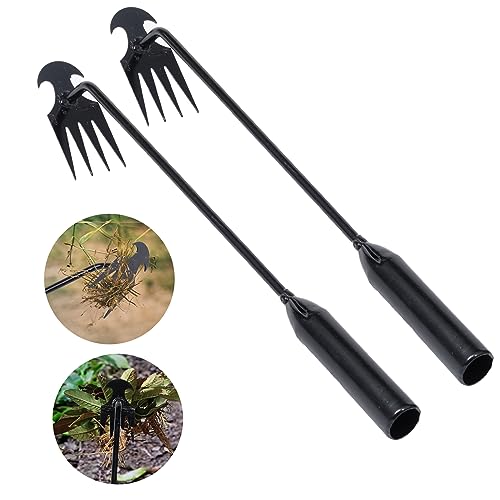
Garden Weed Puller Tool (4-Teeth Forged Hand Weeder)
A compact hand weeder with a forged four-tooth head, built to slide under a weed and lever it out with the root attached. Specs below are drawn from the Amazon listing.
Check price on AmazonWho it is for
This tool reads, on paper, as a good match for gardeners whose main enemy is taproot weeds. Dandelions, dock, thistle, plantain and similar plants that regrow from a deep central root are exactly what a forked puller is built to tackle, because the whole point is lifting the root rather than decapitating the weed. If your flower beds and lawn edges keep sprouting the same offenders week after week, a root-pulling design addresses the cause instead of the symptom.
It also suits close, detailed work. Around established plants, along border edges, and inside raised beds, a short hand tool gives you the precision to target one weed without disturbing the roots of everything next to it. Gardeners who work in short, focused sessions and are comfortable kneeling or crouching will get the most from it. And because it is a purely mechanical tool, it fits anyone who prefers chemical-free weeding and wants to keep sprays out of a vegetable patch.
Strengths on paper
Judging only by the listing, the appeal is easy to summarise. The root-removal geometry is the headline strength: a forked head aimed at lifting the whole weed is genuinely better suited to taproot plants than slicing or surface tools. The forged manganese steel head is a sensible material claim for a tool whose job is prying, since the neck is where cheaper weeders tend to fail. The small, portable form gives you real precision around plants and in tight raised-bed spaces. It is a simple manual tool with no batteries, refills, or chemicals to buy, which keeps running cost at zero and makes it friendly for edible gardens. For a gardener who mostly fights individual broadleaf weeds by hand, that combination is a logical fit.
Things to check before you rely on it
A few realities of weed pulling matter more than any spec, and they are worth setting expectations around.
It works best in moist soil. Damp, worked ground lets the teeth penetrate and the root slide out instead of snapping. In dry, baked, or compacted soil the same weed fights back harder, so weeding after rain or a watering will make a bigger difference than the tool brand ever will.
Removing the whole root is what prevents regrowth. The tool is designed to lift the taproot, but you still have to use it that way. If the root breaks and a section stays in the ground, many weeds simply grow back, so patient leverage beats a quick yank.
It is a hand tool, not a stand-up weeder. You use it kneeling or crouched. For gardeners with back or knee trouble, long sessions at ground level are the real limitation, and a stand-up root remover may be kinder even if it is less precise.
Head durability in rocky soil is the open question. Forged manganese steel should be tough, but four relatively thin teeth are most at risk when you pry against a buried stone. In stony ground, work the angle and avoid forcing the lever, and keep an eye on whether the teeth stay aligned over time.
How it compares
It helps to place this tool among the three common ways gardeners pull weeds by the root. A hand weed puller like this one trades reach for control. You get precise, close-in access around plants and in raised beds, at the cost of working down at ground level. A stand-up root remover flips that trade: you work from a standing position, which protects your back on open lawns, but you give up the fine control needed for crowded beds and you carry a bulkier tool. And chemical-free pulling by hand, with gloves alone, costs nothing and works for shallow weeds, but it rarely gets a full taproot and is miserable in firm soil.
Seen that way, a forked hand weeder occupies a clear niche. It is the tool for someone who weeds up close, values getting the root out, and is comfortable kneeling to do it. If most of your weeding is on a large open lawn and your back is the limiting factor, lean toward a stand-up design instead. If you only face the occasional soft-soil weed, your hands may be enough. The forked puller earns its place when precise, root-deep removal in beds and borders is the recurring job.
Verdict
On paper, this garden weed puller is a focused, sensible tool rather than a do-everything gadget. The forged four-tooth head is well matched to its one real job, lifting taproot weeds out whole, and the portable manual design suits precise, chemical-free work in beds, borders, and raised planters. The honest caveats are about use and fit, not the concept: it rewards moist soil and patient leverage, it asks you to kneel, and the fine details of handle length and grip are worth confirming on the listing before you commit. If your weeding is mostly close-up battles with dandelions and other rooted broadleaf weeds, it is a logical, low-cost pick to consider. Gardeners who need to stay standing should weigh a stand-up alternative first. You can read the full current specifications and reviews for this weed puller on Amazon.
Disclosure: This is an editorial, specification-based review written from the product's Amazon listing. We have not personally tested or used the tool, and all specs are listing claims. As an Amazon Associate we may earn from qualifying purchases made through links on this page, at no extra cost to you.