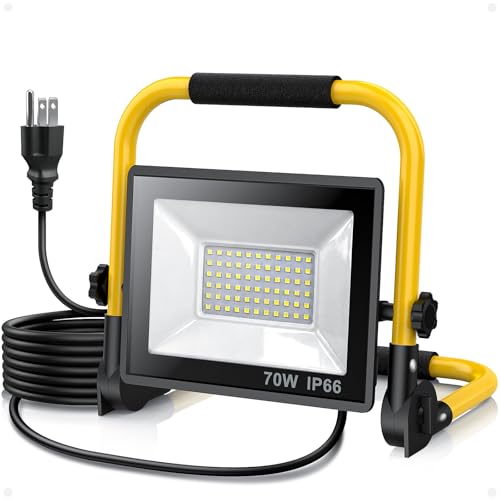
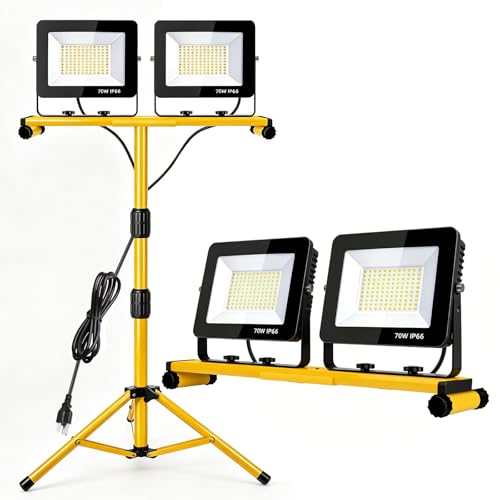
If you want one work light that handles most jobs, the Zetunlo 21000 Lumen LED Work Light with Stand is our top pick. Its three adjustable heads, tall tripod, and long cord throw a wide, even wash of light across a garage bay, a job site, or a driveway project, and the IP66 listing rating means a little dust or weather will not stop it. The rest of this guide explains how we chose, what the numbers on these listings really mean, and which option fits corded, rechargeable, or hands-free work.
Why the right work light matters
A work light is one of those tools you only notice when it is wrong. Too dim, and you squint at the exact spot you are trying to repair. Fixed in one place, and you end up casting your own shadow over the job. A good work light solves both problems by putting plenty of clean, aimable light where your hands are, whether that is under a car, over a workbench, or across a half-built deck.
The lights in this guide fall into two broad families. Corded tripod and panel lights give you the highest output and run as long as they are plugged in, which makes them the natural choice for garages, shops, and job sites. Rechargeable and magnetic lights trade some of that brightness for the freedom to work anywhere, including places with no outlet in reach. Most people end up wanting one of each, and this roundup covers both ends so you can match the light to the task.
How we picked these work lights
We build this guide by reviewing current Amazon listings in the work light category and comparing them on the features and specifications the manufacturers publish, such as stated lumen output, number of heads, cord length, mounting style, battery capacity, color temperature, and ingress protection rating. We then group the options by the jobs they are built for, from whole-room tripods to pocket-sized magnetic lights, and choose a spread that covers the most common needs.
We want to be plain about one thing: we have not physically tested every unit in a workshop. Our picks are editorial judgments based on how each listing describes the product and how its stated features stack up against the alternatives, not lab measurements. Where a listing does not state a figure, such as runtime, we say so rather than guess. Treat the numbers here as manufacturer claims, use them to shortlist, and read recent buyer reviews before you commit.
What to look for in a work light
Lumens as a listing claim. Lumens describe how much light a fixture puts out, and the tripod lights here list figures from 14000 up to 21000, which suits a full garage or outdoor site. A single workbench or under-hood repair is usually happy with something in the 1000 to 10000 range. Remember that the lumen number is a manufacturer listing claim rather than an independently measured value, so give yourself headroom for large spaces and do not chase the biggest number alone.
Corded versus rechargeable. Corded lights run indefinitely and tend to list the highest output, which is why our brightest picks use a cord. Rechargeable lights free you from the outlet and go wherever the work is, but they trade away some brightness and need charging between sessions. If you light the same bay every day, a corded tripod makes sense; if you move around or work outdoors, a rechargeable light earns its place.
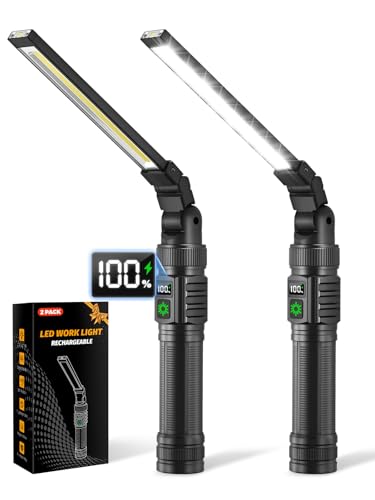
Mounting: stand, magnetic, or hook. How a light holds position matters as much as how bright it is. Tripod and stand lights raise the beam above your work so you are not fighting shadows. Magnetic bases, like those on the Ruboliy and HOTLIGH picks, grip steel so you can stick a light to a car body or tool chest and keep both hands free. Many smaller lights also add a hook or clip for hanging from a beam or an open hood, which is worth looking for if you work in awkward spots.
Runtime. For rechargeable lights, runtime decides how useful they are on a long job. Battery capacity, quoted in mAh on listings like the 5000mAh HOTLIGH, gives a rough guide, but several listings do not state an exact run time. If you need all-day light, a corded model sidesteps the question entirely, while a rechargeable light is best kept topped up so it is ready when you grab it.
Color temperature. Measured in Kelvin, color temperature sets the tone of the light. A daylight white around 5000K to 6500K, like the 6500K COB pick here, renders colors accurately and keeps fine detail crisp, which helps with repair and inspection work. Warmer tones look softer but can mask subtle detail, so for most shop and construction tasks a cooler daylight white is the safer pick.
Durability. Work lights live a hard life, so build quality counts. An ingress protection rating such as IP66, listed on several picks, signals strong resistance to dust and water jets, which matters on a dusty site or in light rain. Look also for sturdy housings, protected lenses, and cords long enough to reach without strain. A light that survives being knocked off a bench is worth more than one extra feature on paper.
Corded or rechargeable: which suits your work
If your work is centered on a fixed space, a corded tripod or panel light is the straightforward answer. You get the brightest listed output, no charging to remember, and a stand that lifts the beam over your project. The Zetunlo and Upgraded tripods sit at this end, with the COB and two-head stand lights covering smaller shops. If you move between jobs, work on vehicles, or need light where there is no socket, a rechargeable or magnetic light like the Coquimbo pack, the Ruboliy pair, or the HOTLIGH is the more practical companion. There is no single right answer, only the right light for how and where you work.
The bottom line
For most people the Zetunlo 21000 Lumen tripod is the work light we would reach for first, with the Upgraded 21000 lumen tripod close behind when you want the brightest fixed setup you can carry. Step down to the COB or two-head stand lights for garage and workbench duty, and keep a rechargeable or magnetic light on hand for the jobs a cord cannot reach. For more options, see our work lights hub and the rest of our tools and home improvement guides.