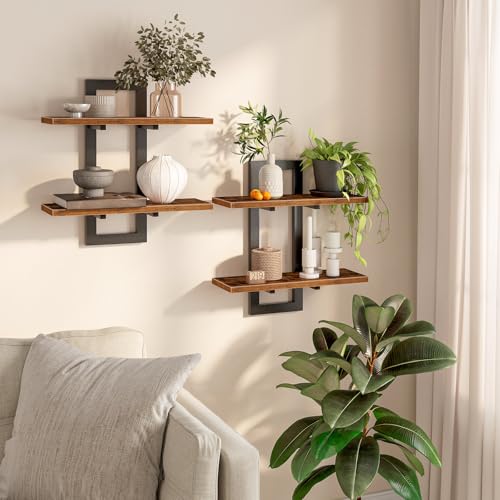
If you want one wall shelf set that handles everyday books, trailing plants, and a row of bathroom bottles without any drama, the BAYKA Floating Shelves, Set of 2, 22.5 in is our top pick. Its longer span and clearly stated 22 lbs listing capacity give you real room to style a wall while keeping installation simple, and the rustic wood finish settles into almost any room. Below we walk through five more sets we would happily hang, then explain exactly what separates a shelf that stays put from one that slowly pulls away from the drywall.
Choosing wall shelves that actually stay up
Wall shelves look effortless in a styled photo, yet the gap between a shelf that floats quietly for years and one that works loose usually comes down to a few unglamorous details. Material matters, the honest weight the shelf can carry matters more, and whether the included hardware ever reaches a wall stud or a proper anchor matters most of all. A beautiful board bolted into bare drywall with the wrong screw is a sagging accident waiting to happen, no matter how good the listing photo looks.
The sets in this guide cover the shapes most people actually need: short pairs for a bathroom, a longer span for a living room, a two tier design for a reading nook, clean white boards with hidden brackets, a large multi piece set for filling a whole wall, and a clear acrylic option for a modern look. None of them ask you to be a carpenter, but all of them reward a few minutes with a stud finder and a level. We kept the list honest and short so you can decide by room and load rather than by marketing copy.
How we picked
We did not physically mount every unit on our own walls, and we are not going to pretend we did. Instead, we selected from current Amazon listings by comparing the features and specifications each maker publishes: set size, shelf length, stated weight capacity, material, mounting style, and finish. Where a listing states a number, such as a 22 lbs capacity or a set of six, we repeat only that figure and never invent our own. Where a listing stays silent, we leave the claim out rather than guess.
Our ratings are editorial judgments about fit and value for a typical home, not lab measurements, so treat them as a starting point for your own comparison. We weighed how versatile each set is across rooms, how clearly the brand documents what the shelf can hold, and whether the design matches a common decorating goal. The result is a spread of options at different sizes and styles, so you can match the shelf to the wall rather than forcing the wall to match the shelf.
What to look for in wall shelves
Material and durability
Most floating shelves are made from engineered or solid wood with a painted or rustic finish, and that covers the majority of this list. Wood takes a knock well and hides minor scuffs, which is why it stays popular for living rooms and bedrooms. Acrylic, like the clear upsimples set, reads lighter and more modern and is easy to wipe clean, though it shows dust and fingerprints sooner. Pick the material for the room and the look first, then confirm the bracket and backing feel solid rather than hollow.
Weight capacity and honest loads
Treat any stated capacity as a ceiling for the whole shelf spread across its length, not a promise for a single heavy object parked in one corner. Several sets here publish a figure, such as the 22 lbs listed for the two larger BAYKA sets, and that number only holds when the shelf is mounted into a stud or a rated anchor. Load the heaviest items closest to the brackets, keep tall stacks of hardcovers to a minimum, and leave a margin under the stated limit so the shelf is working well within its range rather than at the edge of it.
Mounting hardware and studs
This is the step people rush and regret. Wherever you can, drive the screws into a wall stud, because a stud will carry far more than drywall alone. When a stud is not in the right place, use the correct rated wall anchor for your wall type and the weight you plan to add, not just the generic screws that happen to be in the box. Use a level so the shelf sits true, mark your holes before you drill, and respect the capacity the maker lists once everything is tight. A few extra minutes here is the difference between a shelf that floats and one that fails.
Size and set count
Set count decides how much wall you can style at once. A set of two, like the QEEIG or HOOBRO pairs, suits a focused spot above a desk or toilet. A set of three or four opens up a gallery arrangement, and a set of six, like the WOPITUES option, is built for filling a large blank wall in staggered rows. Length matters just as much: a 22.5 in board spans more than a 15 in one and looks more deliberate on a wide wall, while shorter shelves tuck neatly into tight corners and narrow bathrooms.
Style and finish
Finish ties the shelf to the room. Rustic brown wood leans warm and farmhouse, black reads modern and graphic, white with invisible brackets gives the cleanest floating illusion, and clear acrylic almost disappears against a painted wall. Think about what sits on the shelf too, because a busy display calms down on a plain finish, while a sparse, sculptural arrangement can carry a bolder color. Match the finish to the trim and furniture already in the room and the shelves will feel built in rather than added on.
The bottom line
For most people the BAYKA Set of 2 at 22.5 in is the easy recommendation: a generous span, a clearly stated capacity, and a finish that works almost anywhere. Choose the QEEIG pair if you want a simple, compact starting point, the HOOBRO two tier set for a little extra storage in the same footprint, the AMADA white set for the cleanest hidden bracket look, the WOPITUES set of six to cover a whole wall, or the clear upsimples acrylic shelves for a modern, airy feel. Whichever you pick, anchor into a stud or a properly rated wall anchor and stay within the stated weight limit, and the shelf will keep doing its quiet job for years. For more rooms and projects, browse our home improvement guides or the rest of the wall shelves picks.