For growing basil and other leafy herbs indoors, a full spectrum white light is the safest wavelength mix, and the LEOTER Grow Light for Indoor Plants is the one we would set up first. It runs a full spectrum white mode plus a dedicated red and blue mode, so you get the blue wavelengths that keep basil short and bushy together with the red the plant leans on as it grows, and the timer and ten dimming levels let you tune that mix as seedlings turn into a harvestable plant. If you only have a single pot on a counter, a simpler clip lamp like the GooingTop is often all you need.
Quick answer: what wavelength mix basil actually wants
Basil is grown for its leaves, not its flowers, and leafy growth responds most to the blue end of the spectrum, which keeps stems compact and the canopy dense instead of leggy. Red light still matters, because the plant uses it heavily for overall growth, which is why cheap red and blue only panels exist at all. The practical takeaway is that you do not need to hunt for an exact wavelength number. A full spectrum white light already blends blue, green, and red in roughly daylight proportions, and that blend grows basil reliably while also letting you see the true color of the leaves. A light that can also switch to a red and blue mode gives you a second gear if you ever move on to fruiting plants like peppers or tomatoes, but for herbs the white full spectrum setting is the one you will use most.
So the honest version of the answer is this. Pick full spectrum white as your default, treat any red and blue mode as a bonus rather than a requirement, and spend more of your attention on how bright the light is and how close it sits to the plant. Those two things change your results far more than chasing a specific nanometer figure on a product page.
When each pick makes sense
All three lights here are full spectrum LED grow lights aimed at indoor plants, so any of them will grow basil. They differ in how you mount them, how much control you get, and how many pots they can cover.
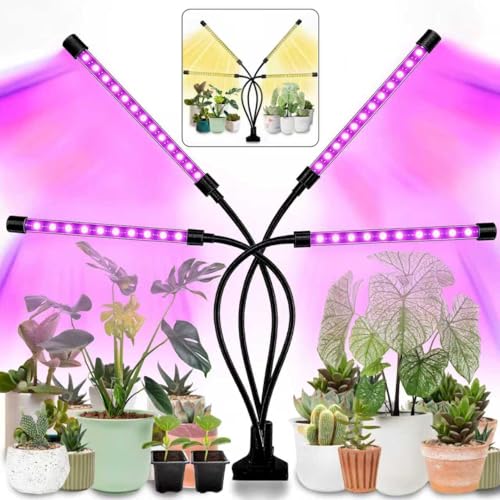
LEOTER Grow Light for Indoor Plants
Full spectrum plus a separate red and blue mode, a 3, 9, or 12 hour timer, ten dimming levels, and a bendable gooseneck, so you can match the light to leafy basil and dial it back while seedlings settle in.
Check price on AmazonThe LEOTER is the most flexible of the three on paper. The listing describes an 80 LED head with both a full spectrum and a red and blue spectrum mode, three switch modes, ten dimming levels, and a 3, 9, or 12 hour repeating timer. For herbs that want a long, consistent day length, a built in timer that comes back on at the same time each day is genuinely useful, and the dimming lets you ease young basil in rather than blasting it. The adjustable gooseneck is what lets it cover more than one small pot. It is the pick to start with if you want one light that can grow along with your setup.

GooingTop 6000K Full Spectrum Grow Light
A 6000K full spectrum clip lamp whose daylight white tone looks natural on a kitchen counter and covers one or two small herb pots without a harsh purple glow.
Check price on AmazonThe GooingTop is the simplest option, and that is the point. It is a 6000K full spectrum clip lamp, so the light reads as clean daylight white rather than the purple glow some panels throw, which matters if the light lives on a kitchen counter or a shelf in a room you actually sit in. For one or two small basil pots it is often all you need. You lose the separate red and blue mode and the longer timer options, so if you want fine control over the mix this is not it, but for a tidy single herb station it is the easy choice.

Aokrean Full Spectrum Grow Light with Base
A full spectrum light on its own weighted base, so a single basil plant on a desk or shelf gets overhead light with nothing to clamp onto.
Check price on AmazonThe Aokrean takes a different mounting approach. Instead of clamping to an edge, it stands on its own weighted base, which suits a plant sitting in the middle of a desk, table, or shelf where there is nothing to clip onto. It is a full spectrum light, so the spectrum story is the same as the others, and the decision here is really about placement rather than wavelengths. Choose it when a clip or a gooseneck clamp would have nowhere to grab.
What actually matters, and what to ignore
Once you accept that full spectrum white covers basil, the specs that change your harvest are intensity, distance, and coverage, not the spectrum label.
Full spectrum versus red and blue. Full spectrum white is the easier, more forgiving default for herbs and the only mode most basil growers ever need. A red and blue mode, like the one the LEOTER offers, is a nice extra for flowering and fruiting plants but is not a reason to buy by itself. Do not let a long list of spectrum modes talk you out of a simpler light if all you grow is basil, mint, and similar leafy herbs.
Real intensity and distance. This is the setting people get wrong most often. An LED grow light that sits too far away gives weak, stretched, pale basil no matter how good its spectrum is. Keep the head close, usually a hand span or so above the canopy, and move it up as the plant grows. If a light has dimming, like the ten levels on the LEOTER, start lower for seedlings and raise it as the plant fills in. Wattage figures printed on a listing are a rough claim about the hardware, not a measured output at your plant, so treat them as a loose guide and judge by how your basil actually looks over a week or two.
Coverage. A single clip head like the GooingTop lights a small footprint well, which is perfect for one or two pots and not enough for a tray of six. A gooseneck with multiple heads, or a standing light angled over a cluster, spreads light wider. Match the light to how many plants you really intend to grow rather than to the biggest number on the box.
Timer and dimming. Basil does best with a steady day length, often in the twelve to sixteen hour range, and a repeating timer that switches on at the same time daily takes that off your mind. Dimming helps you avoid scorching tender seedlings. Both are quality of life features rather than deal breakers, but they are the extras most worth paying attention to.
Things you can mostly ignore include exact nanometer charts, dramatic claims about replacing the sun, and comparisons between wattage numbers from different brands, since they are rarely measured the same way.
How the three compare
If you want the most control and room to grow, the LEOTER is the natural first choice, because its full spectrum and red and blue modes, timer, dimming, and gooseneck cover the widest set of situations. If you want the simplest clean looking light for a single herb pot, the GooingTop clip lamp does that with its daylight white 6000K full spectrum output and nothing extra to fuss with. If your basil sits somewhere with no edge to clamp onto, the Aokrean light with a base solves the placement problem while giving you the same full spectrum coverage. None of these is wrong for basil. The right one is whichever matches your space and how hands on you want to be.
Honest verdict
Basil is forgiving about spectrum and fussy about light that is bright enough and close enough, so buy for full spectrum white first and treat spectrum modes as a bonus. The LEOTER wins our top spot because it gives you the most ways to get the intensity and schedule right, which is where real results come from, while still defaulting to the simple full spectrum white most herb growers live on. Step down to the GooingTop clip lamp for a single tidy pot, or the Aokrean base light when you have nowhere to clamp. All three are full spectrum, so the spectrum question is settled before you even choose. The rest is placement, distance, and a steady daily schedule.
For more picks in this section, see our Tools and Home Improvement guides, or browse related home projects like our wall anchors guide and angle grinders guide.