Hamster Habitats
Best Hamster Habitats for a Happy, Healthy Pet
7 picks compared
9 min read
ProductPickly is reader-supported. When you buy through links on our site, we may earn an affiliate commission at no extra cost to you. It never changes our picks.
The short answerFor most owners the BUCATSTATE Hamster Cage 2.0 at around 39 inches is the best all around habitat, giving one hamster a large unbroken floor and room for deep bedding, which matters more than any number of tubes or levels. Want the roomiest floor possible? The 47 inch BUCATSTATE 3.0 goes bigger. Prefer a clear side view? The XiaZ acrylic tank and the Pipleo cabinet cage show the hamster off while holding tall bedding. Match the floor area to your space first, then choose the material and add a large wheel, hides, and a sand bath.
?How we pickedWe compare published specifications, safety certifications and thousands of verified owner reviews, and we do not physically test every unit. Read the full process in our review methodology.
BUCATSTATE Hamster Cage 2.0, Large Enclosure (39 in, White)
★★★★★ 4.6 / 5 Best overall
At roughly 39 inches long this single level enclosure gives a Syrian or dwarf hamster a genuinely large unbroken floor, which is the one thing that matters most for welfare. The low walled bin design lets you pile in deep bedding for burrowing while the open top keeps ventilation and daily access easy.
Approx length 39 in single levelStyle Low walled bin enclosureBedding depth Deep, unbroken floorBest for Syrian or dwarf hamster
- Large continuous floor clears common welfare minimums with room to spare
- Deep walls hold several inches of bedding for real burrowing
- Open single level layout is simple to arrange and clean
- A big footprint needs a dedicated table or shelf
- Open top means you supply your own wheel and hides
Best for: one hamster with plenty of burrowing room
XiaZ Large Hamster Cage, 40 in Acrylic Glass Habitat with Wood Frame
★★★★★ 4.5 / 5 Best panoramic view
This 40 inch tank style habitat pairs clear acrylic panels with a natural wood frame and a ventilated top, giving an unobstructed side view that is easier to watch than looking down through bars. The solid panels hold deep bedding without spilling, which suits burrowing species like Syrians and degus.
Approx length 40 inPanels Clear acrylic, wood frameTop Ventilated mesh lidBest for Syrian, dwarf, or degu
- Clear panels give a full side view with no bars in the way
- Solid walls contain deep bedding for burrowing
- Ventilated top balances airflow with escape safety
- Acrylic scratches and shows dust more than wire
- Heavier to lift and move than a wire cage
Best for: watching a burrowing hamster up close
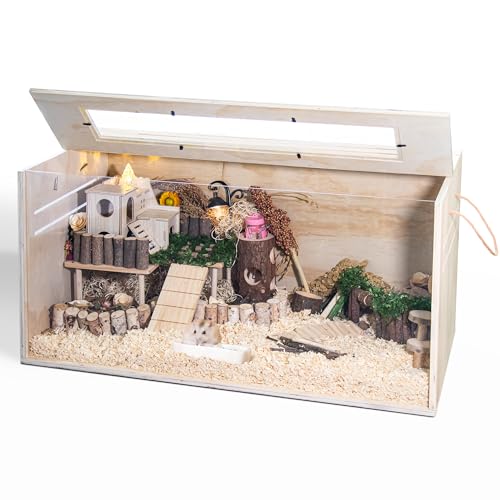
Wooden Hamster Cage, 40 x 20 in with 2 Liners and Vent Windows
★★★★★ 4.4 / 5 Best wooden build
The 40 by 20 inch footprint puts this wooden cage above the continuous floor area most welfare guides ask for, and the two washable liners make deep bedding cleanups far less messy. Adjustable ventilation windows let you tune airflow for the season without leaving gaps a hamster could squeeze through.
Floor size 40 x 20 inMaterial Wood with acrylic frontIncluded 2 washable linersAirflow Adjustable vent windows
- Large floor area comfortably clears common welfare minimums
- Two liners simplify deep bedding cleanup and rotation
- Adjustable vents let you control airflow through the year
- Bare wood can absorb urine odor if a liner is skipped
- Assembly takes longer than a snap together wire cage
Best for: owners who want easy deep clean routines
BUCATSTATE Hamster Cage 3.0, Large Enclosure (47 in, White)
★★★★★ 4.7 / 5 Most floor space
At around 47 inches long this is the roomiest habitat on the list, and for a single hamster more unbroken floor almost always beats extra levels. The extra length leaves space for a large wheel, a deep dig zone, and a sand bath without crowding the enclosure.
Approx length 47 in single levelStyle Extra large bin enclosureBedding depth Deep dig zoneBest for Enrichment focused setups
- Longest floor here, ideal for a large wheel plus a dig zone
- Room to separate sleeping, digging, and sand bath areas
- Single level keeps the whole floor usable and safe
- Needs a wide, sturdy surface to sit on
- Filling a floor this size uses a lot of bedding
Best for: the largest single level floor you can fit
32 in Wooden Chewproof Cage with Acrylic Panels
★★★★★ 4.3 / 5 Best value
A chewproof wooden frame with easy view acrylic panels and an openable top makes this 32 inch cage a solid lower cost entry that still holds deep bedding. It is smaller than the picks above, so it fits a dwarf comfortably and works for a Syrian if you keep the floor open and add a large wheel.
Approx size 32 x 15.7 x 15.7 inMaterial Chewproof wood, acrylicTop Openable lidBest for Dwarf hamster or budget setup
- Chewproof edges resist gnawing better than soft wood
- Acrylic panels give a clear view and hold deep bedding
- Openable top makes spot cleaning and handling easy
- Floor is at the smaller end for an adult Syrian
- No wheel or accessories included in the box
Best for: a dwarf hamster or a lower cost start
Crystal Clear Acrylic Cage, 24.4 x 18.1 in with Stand and Platform
★★★★★ 4.2 / 5 Best acrylic starter
This crystal clear acrylic habitat comes with its own stand and a modular platform, so it is a tidy freestanding option that shows the hamster off from every side. Its 24.4 by 18.1 inch floor sits below the continuous area most guides prefer for a Syrian, so treat it as a dwarf home or a compact starter you plan to upgrade.
Floor size 24.4 x 18.1 inMaterial Clear acrylic with standIncluded Modular platform, starter kitBest for Dwarf hamster or mice
- Freestanding stand means no extra furniture needed
- Fully clear walls give a bright all around view
- Starter kit and platform help a first time owner begin
- Floor is below the ideal continuous area for a Syrian
- Acrylic marks and scratches with regular cleaning
Best for: dwarf hamsters or a freestanding starter
Pipleo 43.3 in Cage with Storage Cabinet and LED Light
★★★★★ 4.4 / 5 Best furniture style
Built as a piece of furniture, this 43.3 inch cage sits on a storage cabinet that holds bedding and supplies while the acrylic panels and LED light keep the living space bright. The long floor suits a single hamster, and the cabinet is a genuine space saver in a small room.
Approx size 43.3 x 15.7 x 43.3 inMaterial Wood, acrylic panelsExtras Storage cabinet, LED lightBest for Small rooms and tidy setups
- Built in cabinet stores bedding and supplies underneath
- Long acrylic front gives a clear, well lit view
- Doubles as furniture so it blends into a room
- Depth is narrower than the widest picks here
- Full furniture piece is heavy and harder to relocate
Best for: a tidy setup with storage built in
The single most important thing in any hamster habitat is unbroken floor space, not the number of tubes or levels. A hamster spends its life on the ground, roaming and burrowing, so a long open floor with deep bedding does far more for its welfare than a tall tower. Set the floor area first, make sure a hamster cannot escape or get stuck, then add the wheel, hides, and dig space that turn a box into a home.
Minimum floor space and why bigger is always better
Hamsters are territorial ground dwellers that would cover long distances in the wild, and cramped housing is linked to repetitive bar chewing and stress behaviors. A widely cited welfare guideline asks for at least around 4,000 square centimetres, roughly 620 square inches, of continuous unbroken floor for a single hamster, which is close to a 40 by 20 inch footprint. Several picks here, including the BUCATSTATE 39 and 47 inch enclosures and the 40 by 20 inch wooden cage, clear that comfortably. Levels and platforms are a nice bonus but do not count toward that ground floor, so always size the base first and treat height as extra.
Wire cage, glass or acrylic tank, or modular tubes
Wire cages ventilate well and are light to move, but the bars invite chewing, they spill bedding, and their small plastic bases rarely give enough deep digging depth. Glass and acrylic tanks, like the XiaZ and Pipleo builds, hold tall bedding without spilling and give a clear side view, at the cost of more weight and needing a good mesh top for airflow. Wooden cages with acrylic fronts split the difference and hold deep bedding well, though bare wood needs a liner to resist odor. Modular tube setups look fun but usually offer tiny floors, poor ventilation, and hard to clean tubes, so treat any tube system as an add on to a large main floor rather than the home itself.
Bar spacing and deep bedding for burrowing
If you do choose a barred cage, spacing matters: dwarf hamsters can slip through gaps wider than about 7 to 8 millimetres, so tight bars or a solid walled tank are safer for small species. Whatever the walls, the floor should let you pile in several inches of bedding, because burrowing is a core natural behavior and shallow trays prevent it. Aim for at least 6 inches of paper based or aspen bedding, deeper if the cage allows, and pack part of it slightly so tunnels hold their shape. The solid walled bins and tanks on this list are built exactly for that kind of deep dig zone.
Cleaning, accessories, and setting it up right
Practical upkeep decides whether a big habitat stays healthy. Removable liners, like the two that ship with the 40 by 20 inch wooden cage, make deep cleans far easier, and an openable top speeds daily spot checks and handling. Spot clean the toilet corner every couple of days and do a full bedding change only every few weeks so you do not wipe out the scent trails a hamster relies on. Every habitat needs a solid, appropriately large wheel, at least one hide, a sand bath, and safe chew items, so budget for those on top of the enclosure. Position the finished setup out of direct sun and away from drafts, and keep the floor open so the wheel and hides never eat into the running space.
Questions people ask
What is the best hamster habitat for most people?
A large single level enclosure with a long unbroken floor, like the BUCATSTATE 39 inch cage, suits most owners. It gives room to roam, holds deep bedding for burrowing, and is simple to arrange and clean.
How much floor space does a hamster need?
A common welfare guideline asks for at least around 620 square inches, or roughly 4,000 square centimetres, of continuous unbroken floor for one hamster. That is close to a 40 by 20 inch footprint, and bigger is always better.
Is a wire cage or a glass tank better for a hamster?
Both can work. Wire cages ventilate well and are light but invite bar chewing and spill bedding. Glass or acrylic tanks hold deep bedding and give a clear view but weigh more and need a mesh top for airflow.
Do hamsters need multiple levels or tubes?
No. Hamsters are ground dwellers, so unbroken floor space matters most. Levels and tubes are a bonus and do not count toward the floor minimum, and cramped tube systems can trap hamsters and are hard to clean.
How deep should hamster bedding be?
Aim for at least 6 inches of paper based or aspen bedding, deeper if the habitat allows, so the hamster can burrow. Packing part of it lightly helps tunnels hold their shape. Solid walled bins and tanks suit deep bedding best.
What bar spacing is safe for a hamster cage?
For dwarf hamsters, bars wider than about 7 to 8 millimetres risk escapes or a stuck head. Choose tight bar spacing or a solid walled tank for small species, and always check the gap before buying a barred cage.
How often should I clean a hamster habitat?
Spot clean the toilet corner every couple of days and do a full bedding change only every few weeks. Removable liners and an openable top make this easier, and over cleaning removes the scent trails a hamster relies on.
What accessories does a hamster habitat need?
Beyond the enclosure, plan for a solid appropriately large wheel, at least one hide, a sand bath, a water source, and safe chew items. Keep the floor open so accessories do not eat into running and burrowing space.
The bottom lineSo which one?
The BUCATSTATE Hamster Cage 2.0 is the best habitat for most owners, giving one hamster a large unbroken floor and deep bedding room at a sensible size. Step up to the 47 inch BUCATSTATE 3.0 for maximum floor, pick the XiaZ acrylic tank or Pipleo cabinet cage for a clear view, and treat the smaller acrylic and 32 inch cages as dwarf homes or starters. Whatever you choose, put floor space and deep bedding first.