
An editorial overview, not a hands-on test
The Weber Traveler is pitched as a portable grill that does not feel like a compromise. Rather than a lunchbox-style tabletop unit, it is a single-burner propane grill that sits on a folding cart with wheels, so the pitch is simple: get close to full-size grilling behavior in something you can roll out of a garage, fold flat, and lift into a vehicle. This review is written from the Amazon listing and Weber's published specifications. We have not cooked on this grill, so nothing here is a hands-on verdict. Instead, this is a spec-based reading designed to help you judge, on paper, whether the Traveler fits how and where you actually grill. Every performance number below is a listing claim, and we flag where you should verify before buying.
Portable grills live or die on tradeoffs. A unit that packs small often gives up grate space, stable footing, or burner output. A unit that cooks well often becomes awkward to move. The interesting question with the Traveler is how Weber balances those pressures, and the listing gives us enough to reason about it carefully.
What it is
The Weber Traveler is a single-burner portable propane gas grill built on a fold-and-roll cart. In practical terms, that means the cooking box, lid, and burner sit on top of a stand that collapses, so the whole grill folds down for transport and storage and rolls on a pair of wheels when it is open. It is designed as an outdoor propane grill, not a tabletop camp stove and not an indoor appliance. The format places it between tiny tabletop grills, which you set on a surface, and full-size cart grills, which stay on a patio. The Traveler aims to be mobile like the first group while cooking more like the second.
Because it is a single-burner design, it runs one continuous cooking zone rather than multiple independent burners. That shapes how you would use it: it is built for straightforward grilling of burgers, sausages, chicken, and vegetables for a small to medium group, rather than for running several separate heat zones at once.
Key features per listing
Here is how the listing and published specifications describe the Traveler. Treat these as manufacturer claims to confirm on the product page, since listings can change and configurations vary.
- Cooking area: the listing describes a single large cooking surface, stated around 320 square inches, which is generous for a portable grill and is the number most directly tied to how many people you can feed at once.
- Burner output: a single burner rated around 13,000 BTU per hour of input according to the published specs. BTU is an input figure, not a direct measure of cooking results, so read it as a rough indicator of heat on tap rather than a guarantee of searing power.
- Fold-and-roll cart: the defining feature. The grill is designed to fold compactly for transport and to open on a stand with wheels, so you move it without lifting the full assembly and store it in a smaller footprint.
- Ignition: the listing describes a built-in igniter for lighting the burner, which is the expected convenience on a grill at this level and removes the need for a separate lighter in normal use.
- Build and grates: Weber describes porcelain-enameled cast-iron cooking grates and a lidded cooking box, consistent with the brand's broader lineup. Cast-iron grates are associated with heat retention and sear marks, while the lid lets you cook with the hood down.
- Fuel: it is a propane grill. The listing frames it for standard propane use, and you should confirm which cylinder or tank setup your unit expects before your first cook.
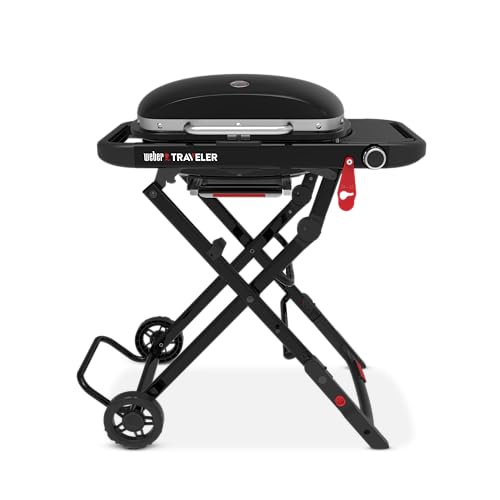
Weber Traveler Portable Gas Grill
Single-burner portable propane grill on a fold-and-roll cart, designed for tailgating, camping, and small patios. Specs below are listing claims.
Check price on AmazonNone of the above reflects our own cooking. It is a structured summary of what the seller states, organized so you can compare it against your needs.
Who it is for
On paper, the Traveler is aimed at a few clear buyers. Tailgaters are an obvious fit, because the fold-and-roll format is built around loading a grill into a vehicle and setting it up in a parking lot or field. Campers and people heading to a cabin or beach day get the same benefit, assuming they have a stable, open, outdoor spot to set up. Owners of small patios, balconies with outdoor clearance, or compact yards may also like it, since it folds away when not in use instead of occupying space permanently. Finally, it speaks to existing Weber fans who want the brand's grilling approach in a portable body rather than buying a second full-size cart grill.
It is less obviously aimed at someone who needs multiple independent heat zones, who routinely cooks for large crowds, or who wants a permanent built-in patio centerpiece. For those uses, a larger multi-burner grill would be the more natural category.
Strengths on paper
Judged purely by the listing, several things stand out. The first is grate space relative to portability. A cooking area in the range stated is large for a grill designed to fold and roll, which suggests you are not giving up much capacity to gain mobility. The second is the cart itself: a fold-and-roll design with wheels addresses the single biggest friction point of portable grilling, which is moving and storing the thing. The third is the single large cooking zone, which keeps operation simple and is well suited to the kind of casual, feed-the-group cooking portable grills are bought for. The fourth is brand consistency: the described grates, lidded box, and igniter line up with what buyers expect from Weber, which matters for parts availability and long-term familiarity. These are reasons the Traveler reads well on specification. They are not a substitute for cooking on it.
Things to check before you buy
A spec-based review is most useful when it tells you what to verify. Start with cooking area versus crowd size. The stated square inches sound generous, but map them to how many burgers or pieces of chicken you realistically cook at once, because a single zone fills up faster than a multi-burner grill. Next, confirm weight and folded dimensions against your vehicle and storage. Portable is relative, and this is a cart grill rather than a featherweight tabletop unit, so check that the folded size fits your trunk or closet and that you are comfortable loading it. Then confirm the propane setup. Verify on the listing which cylinder or tank your unit uses and whether any adapter or hose is included, so you are not caught short on your first cook. Finally, weigh value in terms of what you get rather than headline cost. We do not quote pricing here, so judge it on capability for your use: capacity, portability, and build against how often you will actually move and use it.
How it compares
It helps to place the Traveler against the two neighbors most shoppers consider. Compared with a tabletop portable gas grill, the Traveler trades ultimate smallness and the lowest weight for a bigger cooking surface and a stand you do not have to source separately. A tabletop unit wins if your priority is the most compact, lightest option and you already have a sturdy surface to set it on. The Traveler wins if you want more grate space and an integrated, rollable base.
Compared with a full-size cart grill, the Traveler gives up multiple burners, maximum capacity, and side tables or extra features in exchange for folding down and traveling. A full-size grill is the better choice for a fixed patio and large, frequent cookouts. The Traveler is the better choice when the grill needs to move, pack away, or travel with you. Seen that way, it is less a direct rival to either and more a deliberate middle path: close to full-size grilling character in a body that folds and rolls.
Verdict
On the listing and published specs, the Weber Traveler looks like a thoughtfully designed answer to one specific problem, which is wanting real grilling capability that you can move and store easily. The combination of a large single cooking zone, a fold-and-roll cart, built-in ignition, and Weber's familiar grate and build descriptions reads as a coherent portable package rather than a shrunken afterthought. Whether it is right for you comes down to the checks above: cooking area against your group size, folded size and weight against your vehicle and storage, and the propane setup your unit expects. If those line up with how you grill, it is a sensible option to shortlist. Before deciding, read the current details for yourself and confirm the specs on the Weber Traveler on Amazon.
Safety note
This is an outdoor propane grill. Use it outdoors only, in a well-ventilated area, and keep it away from structures, overhangs, walls, and anything flammable. It burns propane, so handle the fuel, connections, and ignition exactly as the owner's manual directs, and never operate it indoors or in an enclosed space. The cooking area and BTU figures in this review are listing claims from the seller and Weber's published specifications, not measurements we took. Always follow the manufacturer's instructions and local regulations.
Disclosure: This is an independent, editorial, spec-based review built from the Amazon listing and published specifications. We have not tested, used, or cooked on this grill, and all performance figures are listing claims. As an Amazon Associate we may earn from qualifying purchases made through links on this page, at no extra cost to you.