Trekking Poles
Best Trekking Poles for Hiking and Backpacking
7 picks compared
10 min read
ProductPickly is reader-supported. When you buy through links on our site, we may earn an affiliate commission at no extra cost to you. It never changes our picks.
The short answerFor most hikers, the best all-round trekking pole is an aluminum pole with a cork grip and quick flip locks, because aluminum bends rather than snaps under stress, cork wicks sweat and shapes to your hand, and flip locks are fast to set and easy to trust. If you count every gram for fast hiking or trail running, a folding carbon pole is lighter and packs down small, though carbon is more brittle if you lever it sideways in rocks. The two things that decide the right pole for you are how you carry it, telescoping poles slide down for lashing to a pack while folding poles collapse into short sections for a running vest, and your height, since the pole has to reach a level where your elbow sits at a right angle. Below are seven picks that cover aluminum and carbon, telescoping and folding, plus a heavy-duty option for taller and heavier hikers.
?How we pickedWe compare published specifications, safety certifications and thousands of verified owner reviews, and we do not physically test every unit. Read the full process in our review methodology.
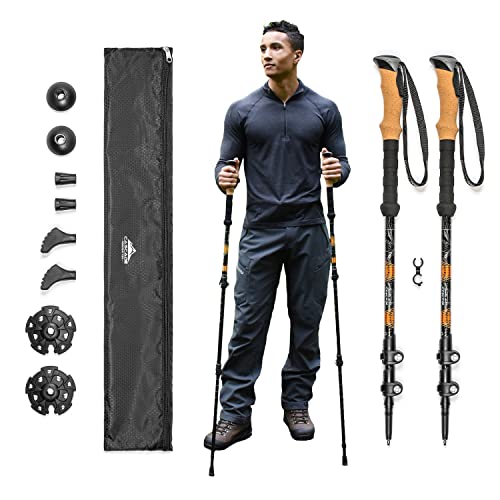
Cascade Mountain Tech Trekking Poles, 6061 Aluminum, Cork Grip
★★★★★ 4.6 / 5 Best overall
This set pairs an aircraft-grade 6061 aluminum shaft with a natural cork grip and external flip locks, which is the combination most hikers reach for first. Aluminum tends to bend rather than shatter if you catch a pole between rocks, the cork handle wicks sweat and molds to your palm over time, and the flip locks let you change length quickly with gloves on.
Material 6061 aluminum shaftGrip Cork with EVA extensionLock External flip lockMax length Expands to 54 in
- Aluminum shaft resists snapping under side load
- Cork grip stays comfortable when hands sweat
- Flip locks adjust fast even with gloves
- Heavier than a comparable carbon pole
- Telescoping design is bulkier than a folding pole
Best for: hikers who want one dependable pole for most trails
Black Diamond Distance Carbon Z Poles, Z-Folding
★★★★★ 4.6 / 5 Best ultralight
These are Z-folding carbon poles built for hikers and runners who want the least weight and the smallest packed size. The three sections collapse into a short bundle that tucks into a running vest or the lid of a pack, and the carbon shaft keeps the swing weight low over long days. Because these come in a fixed length by size rather than a wide adjustment range, you choose the pole length to match your height.
Material Carbon fiber shaftFold type Z-fold, three sectionsLength Fixed by size (110 cm shown)Best use Fast hiking and trail running
- Very light carbon shaft for long miles
- Folds down small for a vest or pack lid
- Quick deploy with the internal cord
- Carbon is more brittle if levered sideways in rocks
- Fixed length means you must pick the right size
Best for: fast hikers and runners who want minimum weight and pack size
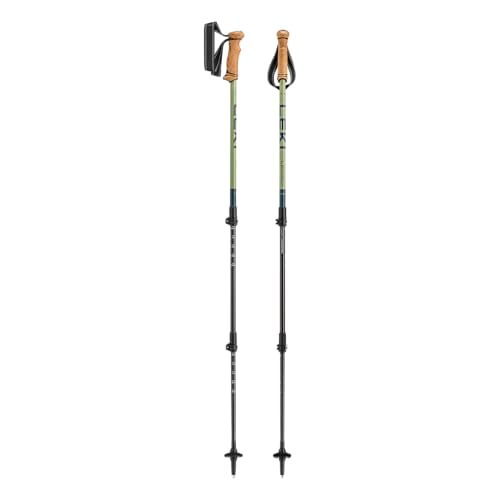
LEKI Legacy Lite Trekking Poles, Aluminum, 100 to 135 cm
★★★★★ 4.5 / 5 Best brand feel
LEKI is a long-standing name in poles, and the Legacy Lite is a telescoping aluminum set that adjusts across a wide 100 to 135 cm range. That span suits a broad range of heights and lets you shorten the poles for climbs and lengthen them for descents. It is the pick for hikers who want a known brand and a straightforward adjustable pole rather than a specialized folding design.
Material Aluminum shaftAdjustment 100 to 135 cmType TelescopingBrand LEKI
- Wide length range fits many hikers
- Established pole brand with a solid feel
- Adjustable for climbs and descents
- Telescoping poles pack longer than folding ones
- Fewer color and grip options listed
Best for: hikers who want a trusted brand and a wide adjustment range
TrailBuddy 3K Carbon Fiber Hiking Poles, Collapsible, EVA Grips
★★★★★ 4.5 / 5 Best carbon value
This TrailBuddy set brings a 3K carbon fiber shaft to a more accessible price and ships with EVA foam grips plus an all-terrain tip and basket kit. Carbon keeps the weight down for its length, and the included accessories mean you can swap between rubber tips for pavement and carbide tips for dirt without buying extras. It is a sensible way to try carbon without stepping up to a premium set.
Material 3K carbon fiber shaftGrip EVA foamType Collapsible telescopingIncluded All-terrain tips and baskets
- Carbon shaft at a friendly price point
- Comes with tips and baskets for mixed terrain
- EVA foam grips are light and easy to clean
- Foam grips wear faster than cork over years
- Carbon needs care around levering forces
Best for: hikers who want carbon and a full accessory kit for less
Trekology Trek-Z Folding Trekking Poles, Aluminum
★★★★★ 4.4 / 5 Best budget folding
The Trek-Z is a tri-fold aluminum pole that collapses into short sections and locks to length with a quick adjustment, giving you a compact folding pole without a carbon price. It suits day hikers and travelers who want poles that stow in a carry-on or daypack. Aluminum keeps it forgiving if it takes a knock, which is reassuring for a pole you will pack and unpack often.
Material Aluminum shaftFold type Tri-fold sectionsAdjustment Quick length adjustBest use Day hikes and travel
- Folds small for travel and daypacks
- Aluminum shrugs off knocks
- Simple quick length adjustment
- Heavier than a carbon folding pole
- Foam grip is basic on longer days
Best for: day hikers and travelers wanting an affordable folding pole
York Nordic Big and Tall Motivator Walking Poles, 2 Piece
★★★★★ 4.4 / 5 Best for taller, heavier hikers
Most poles top out around average heights and weights, so this York Nordic set fills a real gap: it extends for heights up to seven feet and is rated to support users up to 500 pounds. It uses strong push-button locks, detachable rubber feet for hard surfaces and comes with a travel bag. For balance work, rehab or simply for larger hikers, this is the pick that actually fits.
Material Aluminum shaftFits height 4 ft up to 7 ftWeight rating Up to 500 lbLock Push-button, detachable feet
- Extends far for very tall users
- High weight rating for stability and rehab
- Detachable rubber feet for hard surfaces
- Heavier and less packable than trail poles
- Overbuilt if you are average height and weight
Best for: taller or heavier hikers who need extra reach and support
covacure Folding Hiking Poles, 7075 Aluminum, Tri-fold, 2 Pack
★★★★★ 4.4 / 5 Best compact travel
This covacure pair uses a stronger 7075 aluminum alloy in a tri-fold design that collapses short and still adjusts for height once deployed. The folding format makes it easy to stash in luggage or a pack, and the two-pack format means you have a matched set out of the box. It is a practical travel and day-hike option that leans on aluminum toughness rather than carbon lightness.
Material 7075 aluminum shaftFold type Tri-fold sectionsAdjustment Adjustable height after unfoldingSet 2 poles
- 7075 alloy is a tougher aluminum grade
- Folds compact for travel and stowing
- Adjustable length once unfolded
- Heavier than carbon folding poles
- Basic grips compared with cork
Best for: travelers wanting a compact, tough folding aluminum set
A good set of trekking poles does quiet, useful work: it steadies you on loose ground, saves your knees on the way down, and lets your arms help push you up. The catch is that poles differ in ways that matter once you are miles from the car, mainly shaft material, lock and fold type, grip, and how the pole sizes to you. This guide sorts the picks by those real differences so you can match a pole to how you hike rather than to a spec sheet.
Aluminum versus carbon, and why weight is not the whole story
The shaft material is the first real decision. Aluminum, usually a 6061 or tougher 7075 alloy, is the durable all-rounder: under a heavy side load it tends to bend rather than snap, so if you trap a pole between rocks you are more likely to end up with a dent than a broken trip. Carbon fiber is lighter for the same length, and that lower swing weight genuinely adds up over a long day of lifting the pole thousands of times. The trade is brittleness: carbon handles straight-down loads well but is more likely to crack if you lever it sideways or pinch it in a crack. As a rule, choose aluminum if you hike rocky, scrambly terrain or want a pole you can be rough with, and choose carbon if you count grams for long miles or fast running and will treat the poles with a bit of care.
Telescoping versus folding lock types
How a pole collapses shapes how you carry it. Telescoping poles slide their lower sections up inside the shaft and clamp with external flip locks or internal twist locks. Flip locks are the easier choice: you can see they are shut, set them with gloves on, and tighten the tension screw if they ever slip. Twist locks are cleaner looking but can loosen or seize, so many hikers prefer flip. Folding poles are different: they break into three short sections joined by an internal cord, snap together like tent poles, and lock at a set length. Folding poles pack much smaller, which is why runners and travelers like them, but they usually offer less length adjustment than a telescoping pole. If you lash poles to a pack and want a wide adjustment range, go telescoping; if you stuff them in a vest or carry-on, go folding.
Grips, tips and baskets that suit your hikes
The grip is what your hand lives on all day. Cork wicks sweat, resists odor and slowly molds to your palm, which makes it the comfortable pick for long or warm hikes. EVA foam is lighter and softer to the touch but wears faster over the years, while rubber insulates against cold and shock and suits winter use, though it can feel clammy in heat. Down at the business end, most poles use a hard carbide or steel tip that bites into dirt, rock and ice, with rubber tip covers you slide on for pavement or to protect floors. The baskets, the small discs above the tip, keep the pole from sinking: compact trekking baskets handle mud, while wide snow baskets stop the pole from plunging into soft snow. Several sets here include a mix of tips and baskets so you can adapt to the terrain.
Sizing poles to your height
A pole only helps if it is the right length. The simple test is to stand with the tip on the ground and grip the handle: your elbow should sit at roughly a right angle, forearm level with the floor. A common starting estimate is your height in centimeters multiplied by about 0.68, then fine-tuned from there. Adjustable telescoping poles make this easy and even let you shorten them a little for steep climbs and lengthen them for long descents, so your arms stay in a comfortable position throughout. Fixed-length folding poles do not adjust much, so you must buy the size that matches your height, and taller or heavier hikers should check both the maximum length and the weight rating before choosing. Getting the length right is what turns a pole from a thing you carry into a thing that carries part of you.
Questions people ask
Are trekking poles really worth using?
For most hikers, yes. Poles take a share of the load off your knees on descents, improve balance on uneven ground and stream crossings, and give your arms a role in propulsion on climbs. The benefit is largest on steep, rough or heavily loaded hikes, and smallest on flat, smooth paths.
Aluminum or carbon trekking poles, which should I pick?
Aluminum bends rather than snaps and shrugs off knocks, which makes it the safer all-round choice, especially on rocky terrain. Carbon is lighter for the same length and reduces swing weight over long days, but it is more brittle if you lever it sideways or trap it between rocks. Pick aluminum for durability, carbon for weight savings.
What is the difference between telescoping and folding poles?
Telescoping poles slide down into themselves and are easy to lash along the side of a pack. Folding poles break into short sections joined by an internal cord, so they collapse smaller and fit a running vest or carry-on. Folding poles pack tighter, while telescoping poles usually offer a wider length adjustment range.
How do I choose the right trekking pole length?
Set the pole so that when the tip is on the ground and you hold the grip, your elbow sits at roughly a right angle. Many hikers land near their height in centimeters times 0.68. Adjustable poles let you shorten them for climbs and lengthen them for descents; fixed-length folding poles must be bought in the size that matches your height.
Cork, foam or rubber grips, which is best?
Cork wicks sweat, resists odor and molds to your hand over time, so it is the choice for long, warm hikes. EVA foam is light, soft and cheaper but wears faster. Rubber insulates against cold and vibration, which suits cold-weather use, though it can feel sweaty in heat.
What are the tips and baskets for?
Most poles have carbide or steel tips that bite into dirt, rock and ice. Rubber tip covers slide over them for pavement and to protect floors. Baskets are the discs near the tip: small trekking baskets keep the pole from sinking in mud, while larger snow baskets stop it from plunging deep into soft snow.
Should I use one pole or two?
Two poles give the most balance and share the load evenly, which is why most hikers use a pair. A single pole or a walking staff can be enough for light trails, casual walking or when you want one hand free, but for descents and heavier packs two poles are noticeably more stable.
Can trekking poles help with knee pain?
They can reduce the impact your knees absorb on downhills by transferring some force through your arms and the poles. They are not a medical fix, but many hikers with sensitive knees find descents more comfortable with poles. If you have a specific injury, treat this as general trail advice rather than clinical guidance.
The bottom lineSo which one?
For most hikers the best starting point is an aluminum pole with a cork grip and flip locks like the Cascade Mountain Tech set, because it balances durability, comfort and easy adjustment at a sensible weight. If you hike fast or run trails and want the least weight and smallest packed size, step up to a folding carbon pole such as the Black Diamond Distance Carbon Z, keeping in mind carbon needs a little more care around rocks. Taller or heavier hikers should look at the York Nordic Motivator for its reach and weight rating, and anyone who travels often will appreciate a compact tri-fold. Match the pole to how you carry it and to your height, and any of these will serve you well.