Wooden Cutting Boards
Best Wooden Cutting Boards for Everyday Chopping and Serving
7 picks compared
9 min read
ProductPickly is reader-supported. When you buy through links on our site, we may earn an affiliate commission at no extra cost to you. It never changes our picks.
The short answerFor most kitchens the Ironwood Gourmet Charleston End Grain Board is the standout pick, because its end grain construction is the layout that treats knife edges most gently while staying heavy and stable on the counter. If you want a light matching set at an easy entry point, the three piece bamboo boards are the value choice, while the ROYAL CRAFT WOOD bamboo board with a deep juice groove is the one to get for carving meat and slicing juicy produce. The thick Sonder acacia board suits heavy daily prep, the small walnut Brazos board handles quick jobs and table side serving, and the large acacia board with a handle plus the plastic free acacia board round out serving and everyday needs. Choose by grain construction, wood type, and the size and thickness you can store and lift.
?How we pickedWe compare published specifications, safety certifications and thousands of verified owner reviews, and we do not physically test every unit. Read the full process in our review methodology.
Ironwood Gourmet Charleston End Grain Board
★★★★★ 4.7 / 5 Best overall
This is the board most home cooks should look at first, because end grain construction is the layout that treats a knife edge most gently. The end of each wood fiber faces up, so the blade parts the fibers instead of slicing across them, which keeps your edge sharper for longer and hides fine cut marks over time. It is a thick, heavy acacia block that stays planted on the counter while you work.
Wood AcaciaGrain End grainSize Thick chef blockBest use Heavy daily chopping
- End grain layout is the kindest to knife edges
- Thick heavy block sits still while you cut
- Acacia is dense and holds up to daily prep
- Heavier to lift and store than thin boards
- End grain needs regular oiling to avoid drying
Best for: the most knife friendly everyday chopping surface
Bamboo Cutting Board 3-Piece Bread Board Set
★★★★★ 4.5 / 5 Best value
A three board bamboo set aimed at people who want a matching range of sizes without paying for a single heavy block. Bamboo is a fast growing grass rather than a hardwood, so it is light and easy to move between the sink and the counter, and having three boards lets you keep raw meat, produce, and bread on separate surfaces. It is a sensible starting point for a first kitchen or a busy one.
Wood BambooGrain Edge grainSize Three graduated boardsBest use Separating raw and ready foods
- Three sizes cover most everyday jobs
- Bamboo is light and easy to handle
- Separate boards help keep raw foods apart
- Bamboo is harder and less gentle on edges
- Thin boards can flex under heavy chopping
Best for: a light matching set at an easy entry point
ROYAL CRAFT WOOD Bamboo Board with Juice Groove
★★★★★ 4.4 / 5 Best juice groove
For anyone who carves roasts or slices juicy fruit, this bamboo board leans on a deep channel cut around the edge to catch runoff before it reaches the counter. The recessed side handles give you a firm grip when the board is loaded and wet, which is when a flat board is most awkward to carry. It is the pick to reach for when mess control matters as much as the cutting itself.
Wood BambooGrain Edge grainSize Large board with grooveBest use Carving and juicy produce
- Deep groove catches juices from meat and fruit
- Side handles help carry a loaded board
- Doubles as a serving and charcuterie surface
- Groove takes a little more effort to clean
- Bamboo is firmer on knife edges than hardwood
Best for: carving meat and cutting juicy produce cleanly
Sonder Los Angeles Winsome Acacia Board
★★★★★ 4.6 / 5 Best heavy duty
A thick acacia board at roughly one and a half inches deep, built for cooks who want a substantial surface that does not slide or bounce under a heavy knife. The extra mass is the whole point here, giving you a stable base for breaking down produce or portioning meat, and the generous footprint leaves room to push trimmings aside as you go. It reads as a serious daily driver rather than an occasional board.
Wood AcaciaGrain Edge grainSize 16 by 12 by 1.5 inBest use Stable heavy prep
- Thick block stays planted during hard chopping
- Large surface fits full prep sessions
- Acacia grain looks good enough to serve on
- Heavy to lift, wash, and store
- Large footprint needs real counter space
Best for: a stable heavy board for serious prep
Brazos Home Dark Walnut Small Cutting Board
★★★★★ 4.5 / 5 Best small board
A small walnut board at around eleven by six inches, meant for the quick jobs that do not justify hauling out a full block, like slicing a lemon, a few cloves of garlic, or cheese for a snack. Walnut is a softer, closer grained hardwood that is easy on knife edges and has a deep, even color, so this doubles neatly as a small serving board for cheese or charcuterie at the table.
Wood WalnutGrain Edge grainSize 11 by 6 inBest use Quick tasks and serving
- Compact size suits fast small jobs
- Walnut is soft and gentle on knives
- Doubles as a small cheese or serving board
- Too small for breaking down big produce
- Single small board only, not a set
Best for: quick small jobs and table side serving
Acacia Wood Cutting Board with Handle, 17 by 13
★★★★★ 4.4 / 5 Best large serving
A large acacia board with a built in handle, sized at seventeen by thirteen inches so it works as both a roomy prep surface and a platter you can carry straight to the table. The handle makes it easy to move fully loaded, and the wide face gives you space to lay out cheese, cured meats, bread, and fruit. It suits cooks who want one attractive board that shifts from chopping to serving.
Wood AcaciaGrain Edge grainSize 17 by 13 inBest use Large prep and serving
- Large face fits big prep and full platters
- Handle makes a loaded board easy to carry
- Acacia grain looks presentable on the table
- Big board needs plenty of storage room
- Handle end reduces usable cutting area
Best for: large prep that moves to a serving platter
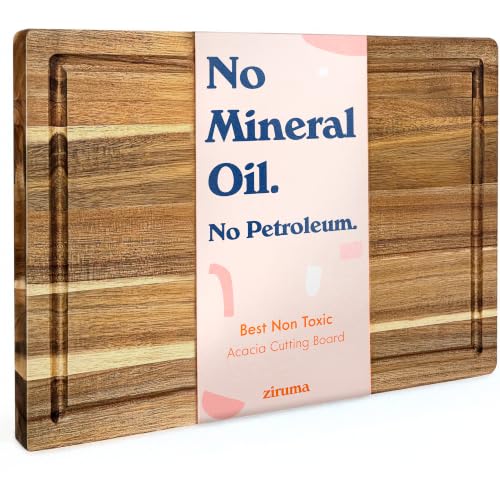
Non-Toxic Acacia Cutting Board, 16 by 11
★★★★★ 4.4 / 5 Best plastic free
A mid size acacia board pitched at people who want to move away from plastic and finishes they cannot identify, with the listing noting it is free of added plastic and finished only with mineral oil. At sixteen by eleven inches it covers most everyday chopping without dominating the counter, making it a straightforward single board choice for a cook who cares about what touches their food.
Wood AcaciaGrain Edge grainSize 16 by 11 inBest use Everyday plastic free prep
- Plastic free build with a mineral oil finish
- Mid size fits most daily chopping tasks
- Single solid board is easy to clean
- Needs regular oiling to keep from drying
- One board only, no size options
Best for: a plastic free single board for daily use
The best wooden cutting board protects your knife edge, sits still while you work, and lasts for years if you oil it and wash it by hand. The right one for you comes down to grain construction, the type of wood, and the size and thickness you can store and lift. The picks below span a knife friendly end grain block, light bamboo sets, a grooved board for carving, thick heavy duty acacia, and small and large boards that double for serving, so you can match one to how you actually cook.
End grain versus edge grain and your knives
The single most important choice is grain direction. An edge grain board shows the long sides of the wood strips, which is strong, affordable, and perfectly good for daily cooking. An end grain board shows the cut ends of the fibers, so the blade parts them like the bristles of a brush instead of slicing across them. That is why end grain boards such as the Ironwood Charleston keep an edge sharper and hide fine cut marks as the fibers close back up. The cost is weight and price, so if you value your knives and chop every day, end grain is worth it, while edge grain is the sensible all rounder for most kitchens.
Wood types: maple, walnut, teak, and bamboo
Wood choice changes how a board feels and lasts. Maple is the traditional workhorse, hard wearing with a tight closed grain that resists scarring. Walnut, seen in the small Brazos board, is softer and the gentlest on knife edges, with a deep even color that serves well at the table. Teak carries natural oils that make it very water resistant. Acacia, used in several picks here, is a dense and affordable hardwood that looks good and handles daily prep. Bamboo, in the three piece set, is light and cheap but technically a grass that is harder on edges, so treat it as a practical everyday option rather than a knife pampering one.
Size, thickness, and the juice groove
Size and thickness decide how a board behaves and where it lives. A small board like the walnut Brazos is ideal for a quick lemon or clove of garlic, while a large board such as the seventeen by thirteen inch acacia doubles as a serving platter but demands storage space. Thickness matters too: a chunky block like the Sonder acacia at an inch and a half stays planted under a heavy knife, whereas thin boards flex and can warp. A juice groove, as on the ROYAL CRAFT WOOD board, catches runoff from roasts and juicy fruit, so pick one if you carve often and a plain flat face if you mostly chop vegetables.
Care: oiling and hand washing
A wooden board lives or dies by how you treat it. Always wash it by hand with warm soapy water and stand it on edge to dry so both faces lose moisture evenly, and never let it soak or go through the dishwasher, which is what splits and warps wood. Every few weeks, or whenever the surface looks dry and pale, work in food safe mineral oil and leave it overnight, then wipe off the excess. A conditioner with beeswax adds extra water resistance. Keep a separate board or face for raw meat, and for a deeper clean scrub with coarse salt and lemon. Do this and any board here will outlast a drawer full of plastic.
Questions people ask
What is the difference between end grain and edge grain boards?
On an edge grain board the long sides of the wood strips face up, which is strong, affordable, and fine for most home cooking. On an end grain board the cut ends of the fibers face up, so the knife slips between fibers rather than cutting across them. That self healing action keeps edges sharper and hides cut marks, which is why end grain boards like the Ironwood Charleston are prized, though they cost more and weigh more. For everyday use either works, but end grain is the gentler choice for a good knife.
Which wood is best for a cutting board?
Closed grain hardwoods are the classic choice because their tight pores resist bacteria and knife scarring. Maple is the traditional workhorse, walnut is softer and easiest on edges with a rich dark color, and teak is very water resistant thanks to its natural oils. Acacia is a dense, affordable hardwood that looks good and serves well, while bamboo is technically a grass that is light and cheap but harder on knives. Any of these is a sound pick if you keep it oiled and hand washed.
Is bamboo a good material for a cutting board?
Bamboo has real advantages: it is light, inexpensive, and grows quickly, so sets like the three piece bamboo boards here are an easy way to start. The trade off is that bamboo is harder than most hardwoods, so it dulls knife edges a little faster and can feel firm under the blade. It also uses glue between strips, so keep it out of long soaks and the dishwasher. For light chopping and separating foods it is fine, but a knife lover may prefer a softer hardwood.
Do I need a juice groove on my cutting board?
A juice groove is the shallow channel cut around the edge that catches liquid from carving meat or slicing juicy fruit before it runs onto the counter. If you often carve roasts or cut watermelon and tomatoes, a grooved board like the ROYAL CRAFT WOOD pick saves cleanup. If you mostly chop vegetables and herbs, a plain flat board gives you more usable surface and is a little easier to scrub. Many cooks keep one of each for different jobs.
How thick should a wooden cutting board be?
Thickness drives stability and longevity. A board around three quarters of an inch is a good everyday thickness that stays flat and does not slide much. Thicker blocks of an inch or more, like the Sonder acacia board, feel planted under a heavy knife and last longer, but they are heavier to lift, wash, and store. Thin boards are easy to handle and cheaper but can flex or warp over time. Match the thickness to how hard you chop and how much lifting you want to do.
How do I care for and oil a wooden cutting board?
Wash by hand with warm soapy water and dry it standing on edge so both faces dry evenly, and never leave a wooden board soaking or run it through the dishwasher, which is what splits and warps them. Every few weeks, or whenever the wood looks dull and dry, rub in food safe mineral oil and let it soak in overnight, wiping off any excess. A board conditioner with beeswax adds extra water resistance. Regular oiling is the single biggest thing that keeps a board from cracking.
How do I keep a wooden board hygienic for raw meat?
Wood is naturally somewhat antibacterial, but the safest habit is to keep a separate board, or a separate face, for raw meat and poultry and another for produce and bread, which is one reason board sets are handy. After cutting raw meat, wash the board promptly with hot soapy water, and for a deeper clean scrub with coarse salt and a cut lemon, or wipe with diluted vinegar, then dry it fully. Avoid soaking or bleach baths, which damage the wood over time.
How did we choose the boards in this guide?
We compared grain construction, wood type, size and thickness, useful features like juice grooves and handles, and how each board fits real jobs from heavy daily chopping to table side serving, then matched every pick to a clear use case. Every product shown is a real listing, and these are our chosen picks based on published details and board design rather than any hands on lab claim.
The bottom lineSo which one?
The Ironwood Gourmet Charleston End Grain Board is our top choice for most cooks, pairing the most knife friendly grain layout with a heavy, stable block for daily chopping. The three piece bamboo set is the value pick for a light matching range, the ROYAL CRAFT WOOD grooved bamboo board is the one for carving and juicy produce, and the thick Sonder acacia board suits serious heavy prep. The small walnut Brazos, the large acacia board with a handle, and the plastic free acacia board cover quick jobs, serving, and everyday needs, so match the board to how you cook and the space you have.