A composition notebook is one of the most dependable items on any school supply list. The sewn binding lays flatter and holds up better than a spiral, the pages do not tear out as easily, and the fixed size slides into almost any bag or bin. The trade off is that there is no single best book for everyone. The right choice comes down to ruling, how many books you need, and whether you want to sort by color.
To keep this guide honest and useful, every pick below is drawn from current Amazon listings and described using what those listings state. We did not rank these books by hype. We grouped them by the job each one does best, from a flexible top pick to a single book for a one off class, so you can match a notebook to how you actually work.
How we chose these composition notebooks
We started with the specifications that matter most for a composition book: ruling style, sheet count, trim size, pack quantity, and cover. Each pick reflects what its product listing states rather than any claim of personal use. We looked for coherent, widely available options across the two rulings, and across pack sizes that fit a single student, a full course load, and a classroom. We avoided overlapping picks so each entry solves a different problem. Where a book comes in assorted colors, we note that the exact colors are not chosen by the buyer. Sheet counts, rulings, and sizes below are listing claims.
The picks
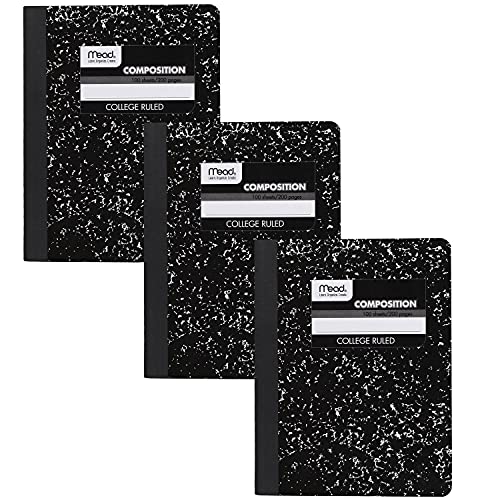
Our Top Pick is the Mead College Ruled three-pack in black marble. It is the most flexible single order on this list. The listing specifies college ruled pages, 100 sheets per book, and the standard 7.5 by 9.75 in trim. Three books cover a few subjects without committing to a bulk case, and college ruling fits more lines per page for older students who write small.
For the Best College Ruled choice, the Mead six-pack in assorted colors wins on organization. The listing lists college ruled pages, 100 sheets per book, and assorted covers, so each class gets its own color. Six books is a sensible quantity for a full course load through a term, and the color coding makes the right book easy to grab in a hurry.
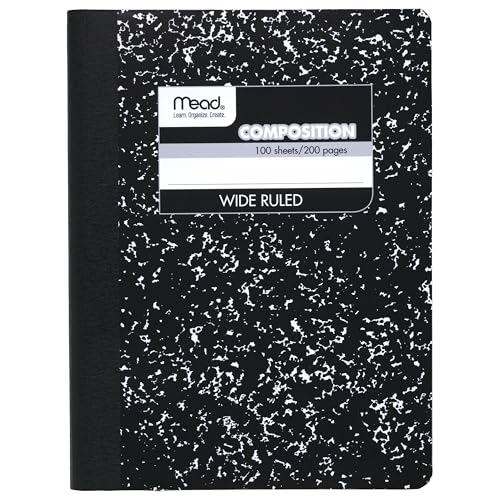
The Best Wide Ruled pick is the Mead wide ruled three-pack in black marble. Wide ruling leaves more room between lines, which helps younger students and larger handwriting stay neat. The listing lists wide ruled pages, 100 sheets per book, and the familiar 7.5 by 9.75 in size. Three books is a practical count for one student spread across a handful of subjects.
When quantity is the point, the Best Value Multipack is the Mead wide ruled twelve-pack. The listing lists wide ruled pages, 100 sheets per book, and black marble covers across all twelve. Buying one case means fewer repeat orders and a uniform book for an entire class or a busy household, which keeps a shared supply list simple.
The Best for School entry is the Amazon Basics wide ruled four-pack in assorted marble colors. Four books is a number that shows up again and again on classroom supply sheets, and the assorted covers make sorting by subject effortless. The listing lists wide ruled pages, 100 sheets per book, and a 9.75 by 7.5 in size.
Finally, the Best Single is the Mead wide ruled single in black marble, for when one book is all you need. The listing lists wide ruled pages, 100 sheets, and the standard 7.5 by 9.75 in trim. It is the cleanest way to add a book for a new class, a journal, or a lab log without buying a multipack you will not use.
What to look for in a composition notebook
College vs wide ruling. College ruling spaces lines closer together, so you fit more writing on each page. It suits older students, small handwriting, and anyone who takes dense notes. Wide ruling gives more room between lines and is easier for younger writers and larger handwriting. Many supply lists specify one or the other, so check the requirement before you buy.
Sheet count. The standard composition book holds 100 sheets, which is 200 pages. Every pick here is listed at 100 sheets per book. That is usually enough for a single subject across a term, though a heavy note taker may want a spare on hand.
Paper quality and bleed. Composition paper is built for pencil and ballpoint pen. Heavier gel pens, fountain pens, and markers can show through or bleed to the other side on standard paper, so test a page if you plan to use wet ink. For everyday class notes with pencil or ballpoint, standard paper is fine.
Sewn binding durability. The stitched binding is the signature of a composition book and the reason it outlasts a spiral for daily carry. There are no metal coils to crush and no perforations that let pages fall out. That makes these books a good fit for backpacks, lab benches, and anywhere a notebook gets knocked around.
Size. The classic composition trim is about 7.5 by 9.75 in, and every pick here sits at that standard. It fits most bags, cubbies, and bins, and it stacks neatly. If you need a book to slide into a specific sleeve or binder pocket, confirm the dimensions first, since a few listings state the size in reverse order.
Single vs multipack for supply lists. If a supply list calls for several books, a multipack is simpler and usually more efficient per book than buying singles. A three-pack or four-pack fits one student across a few subjects, a six-pack covers a full course load, and a twelve-pack suits a classroom or a family stocking up. If you only need one book, a single avoids leftovers.
Covers. Black marble is the traditional look and the easiest to match when a list asks for a plain cover. Assorted color packs let you assign one color per subject, which speeds up grabbing the right book, with the caveat that the specific colors are usually chosen by the seller rather than the buyer.
The bottom line
For most people the Mead College Ruled three-pack is the easiest book to recommend, because it balances a useful quantity with the flexibility to cover several subjects. Choose the college or wide six-packs when you want a color per class, step up to the twelve-pack when you are supplying a group, lean on the Amazon Basics four-pack for a standard school list, and grab the single when one book is all you need. Match the ruling and the pack size to how you work, and any of these will do the job.