The Behringer MICROMON MA400 is one of those small studio boxes that sets out to solve one specific problem rather than trying to do everything at once. It is positioned as an ultra compact monitor headphone amplifier, built so you can hear a blend of a main signal and a direct input through a single pair of headphones. This overview is written from the current Amazon listing and commonly published specifications rather than from first hand use, so read it as a buying guide that helps you decide whether this little unit belongs in your recording setup, not as a report of personal listening.
What it is
The MICROMON name points at its job. It is a personal monitoring amplifier, meaning it is designed for the person who is tracking or performing and needs to hear themselves clearly while they work. The core idea described by the product is simple. You feed it a main signal, which is usually the mix coming back from an interface or console, and you also feed it a direct input, which is often the instrument or microphone channel the performer wants to hear more of. A balance control then lets you decide how much of each you want in the headphones, so a singer can push their own voice up without changing anyone else's monitor feed.
This matters because it is a studio and recording tool, not a home listening amplifier. It is not meant to drive a pair of audiophile headphones for relaxed music enjoyment in the living room. It is meant to sit on a desk, near a mixer, or in a small rack of utility gear, giving one listener an easy way to shape their own monitor blend. Keeping that use case straight is the single most useful thing to understand before buying, because people who expect a hi fi headphone amp will be looking at the wrong category of product.
Key features
Based on how the product is named and described, the feature set centres on a handful of practical controls rather than a long list of extras. You can expect a main input for the primary signal, a direct input for the source the performer wants to emphasise, a control that sets the balance or mix between those two sources, a level or volume control for the headphone output, and a headphone output itself. The appeal is the focus. There are no menus, no screens, and no processing to learn. You plug in two sources, set the blend, set the level, and listen.
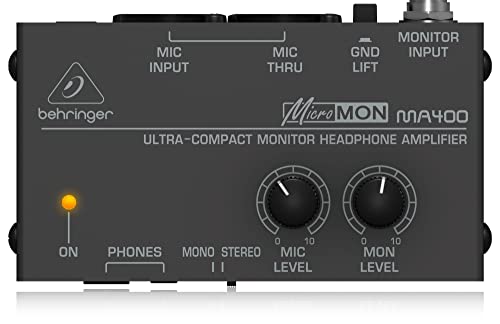
Behringer MICROMON MA400 Ultra-Compact Monitor Headphone Amplifier, Silver
A compact monitor headphone amplifier built to blend a main signal with a direct input for a single listener. Confirm connectors and power on the current listing.
Check price on AmazonBecause the exact connector types, the labelling of each control, and the precise power arrangement can vary between product revisions, treat the list above as the functional idea rather than a wiring diagram. The current listing is the place to confirm the specifics before you commit.
Who it is for
The clearest fit is the home recording musician. If you track vocals or an instrument into an interface and you keep reaching for a way to hear more of yourself against the backing, this is exactly the kind of box that addresses that itch without a large or complicated setup. Musicians monitoring during overdubs are a natural audience too, since the whole point of the balance control is to let a player sit their own part against the existing mix at whatever ratio feels comfortable.
Podcasters and spoken word creators are a third group worth mentioning. A host who wants a simple personal monitor blend, perhaps their own voice against a remote guest or a music bed, can use a single listener blend box like this to stay in control of what they hear. The common thread across all of these users is that they are one person who wants to shape one headphone feed. If your need is to send the same mix to several performers at once, this is not the tool for that job, and the comparison section below explains why.
Strengths on paper
The strongest points are the ones that follow from its narrow focus. It is compact, so it takes up very little desk or bag space. It is simple, so there is almost nothing to set up or misconfigure. The balance control is the headline capability and it directly serves the most common personal monitoring request, which is hearing more or less of yourself. Behringer's budget positioning also makes this an accessible class of device for people building a first home studio, which is why these small utility units show up so often in starter setups. Single purpose gear like this tends to keep working quietly in the background for a long time precisely because there is so little to go wrong.
Things to check
Before buying, confirm the details on the current listing rather than assuming, because small utility boxes are often revised and specifications can change. Check the input and output jack types and sizes, since whether the connectors are quarter inch or the smaller eighth inch size will decide which cables and adapters you need. Check exactly how the mix or balance control behaves and what each input expects. Check the power source carefully, meaning whether it runs on a battery, an external adapter, or both, and whether any adapter is included in the box or bought separately. Check the headphone impedance range the unit is comfortable driving, because very high impedance studio headphones can be more demanding than lightweight consumer pairs. Finally, confirm that the described use fits studio monitoring rather than loud general listening, and verify every one of these points against the live listing before you order.
How it compares
The most helpful way to place the MICROMON MA400 is against the multi channel headphone amplifier category. A multi channel stereo headphone amplifier takes one source and fans it out to several headphone outputs, each with its own level, so a group of performers can all monitor at once. That is a distribution tool for a room full of listeners. The MICROMON approach is different. It concentrates on one listener who wants to blend two sources and set the balance between them. Neither is better in the abstract, they simply answer different questions. If you need several people to hear the same mix, look at the four channel style of headphone amplifier. If you are the single person who wants to control the balance of your own monitor feed, the single listener blend box is the closer match. There is no need to chase any particular rival model here, since the choice is really about which of those two jobs you are trying to do.
Verdict
The Behringer MICROMON MA400 reads as a focused, low cost solution to a very specific monitoring problem, which is letting one person blend a main signal with a direct input and hear the result on headphones. Judged on the listing and published specifications, its appeal is its simplicity and its narrow purpose, and its main risk is being bought by someone who actually wanted a multi listener distribution amp or a home hi fi headphone amp. If the single listener blend is what you need, it is a sensible compact option, and the best next step is to check the current listing to confirm the connectors, power, and headphone compatibility for your own gear before deciding.
This is an editorial overview compiled from the current Amazon listing and published specifications, not a hands on review, and we have not personally used or tested the unit. ProductPickly may earn a commission from qualifying purchases made through links on this page.