PICK
Sony E 18-135mm Review
An honest look at the Sony E 18-135mm F3.5-5.6 OSS lens for APS-C mirrorless cameras. We break down who should buy it, who should skip it, real-world performance, and how it compares to alternatives.
ProductPickly is reader-supported. When you buy through links on our site, we may earn an affiliate commission at no extra cost to you. It never changes our picks.
The Sony E 18-135mm F3.5-5.6 OSS is a versatile travel zoom that covers a useful 27-202.5mm equivalent range in a compact, lightweight body. It delivers sharp images across most of its zoom range, with fast and quiet autofocus, effective optical stabilization, and a rotating zoom ring that works well for video. It is an excellent choice for everyday photography, travel, and vlogging on Sony APS-C cameras. However, its variable aperture limits low-light performance, and it is not a constant-aperture lens, so video shooters who need consistent exposure may prefer the 18-105mm F4. It is also not the sharpest option at the long end, but for most users, the convenience and image quality make it a top all-in-one zoom.
How it scores
The good and the annoying
- Compact and lightweight for its zoom range
- Effective optical SteadyShot stabilization
- Fast, quiet, and accurate autofocus
- Sharp images in the center across most focal lengths
- Rotating zoom ring is smooth and precise for video
- Weather-sealed mount adds durability
- Variable aperture limits low-light performance
- Some softness at the long end (135mm)
- No manual aperture ring on the lens
- Plastic build feels less premium than G-series lenses
- Lens hood is not included in the box
The Sony E 18-135mm F3.5-5.6 OSS is one of the most popular all-in-one zoom lenses for Sony APS-C mirrorless cameras. It aims to be the only lens you need for travel, everyday shooting, and even video. But is it really the jack-of-all-trades it claims to be? Our editorial team compared specifications, buyer feedback, and key decision factors to give you an honest review.
Design and Build
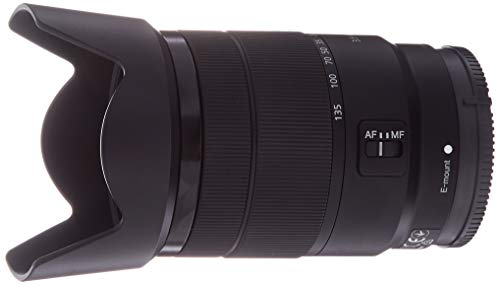
The lens feels solid despite its plastic barrel. It weighs about 325 grams, which is light enough for all-day carry. The zoom ring is smooth and well-damped, and the manual focus ring is electronic but responsive. There is no aperture ring, which may disappoint some enthusiasts, but you can control aperture from the camera body. The mount is metal and weather-sealed, adding durability. The lens hood is not included, which is a minor annoyance, but you can buy one separately.
Performance and Image Quality
Optically, the lens delivers very good results for a superzoom. At wide angles, it is sharp from center to edges. At mid-focal lengths, it remains sharp. At 135mm, there is noticeable softening, especially in the corners, but it is still usable. Chromatic aberration is well controlled, and distortion is minimal (corrected in-camera for JPEGs). The variable aperture means you get f/3.5 at 18mm and f/5.6 at 135mm, which limits low-light performance. However, the OSS stabilization helps you shoot at slower shutter speeds.
Autofocus and Video
The autofocus is fast, quiet, and accurate, thanks to a linear motor. It works well for both stills and video, and it is compatible with Sony's real-time tracking and eye AF on newer cameras. For video, the rotating zoom ring is a big plus, allowing smooth manual zooms. The OSS also helps stabilize handheld footage. The only downside is the variable aperture, which can cause exposure changes when zooming. If you need constant aperture for video, consider the 18-105mm F4.
Handling and Ergonomics
The lens is compact and balances well on A6000-series bodies. The zoom ring is easy to reach, and the focus ring is smooth. There is no AF/MF switch on the lens, but you can assign that to a custom button on the camera. The lens is also lightweight enough for gimbal use, making it a popular choice for vloggers.
Battery and Storage
As a lens, it does not affect battery life directly, but its OSS and AF motors draw power. With a typical camera battery, you can expect around 300-400 shots per charge, depending on usage. The lens uses a 55mm filter thread, so you can use standard filters. There is no built-in storage, obviously, but you will need an SD card in your camera.
Value and Comparisons
The Sony 18-135mm is priced competitively for its versatility. It is more expensive than the kit lens but offers much better reach and image quality. Compared to the Sony 18-105mm F4, the 18-135mm is smaller and lighter, but the 18-105mm has a constant aperture, which is better for video. The Sony 16-55mm f/2.8 G is sharper and faster but has a shorter range and costs significantly more. For most users, the 18-135mm offers the best balance of price, portability, and performance.
Common Buyer Complaints
Some users complain about the lack of a lens hood and the plastic build. Others note softness at 135mm, especially in the corners. A few have experienced autofocus hunting in low light, but that is rare. Overall, buyer feedback is very positive, with many praising the lens as a great travel companion.
Pros and Cons
- Pros: Compact, sharp, fast AF, OSS, great for video.
- Cons: Variable aperture, soft at long end, no hood.
Final Verdict
The Sony E 18-135mm is an excellent all-around lens for Sony APS-C shooters. It is not perfect, but it offers a compelling combination of range, portability, and image quality. If you want one lens for most situations, this is a top choice. Just be aware of its limitations in low light and at the telephoto end. Check the current price on Amazon to see if it fits your budget.
Specs that matter
| Focal length | 18-135mm (35mm equivalent: 27-202.5mm) |
| Aperture | F3.5-5.6 (variable) |
| Mount | Sony E-mount (APS-C) |
| Optical design | 16 elements in 12 groups, including 1 aspherical and 2 ED elements |
| Minimum focus distance | 0.45m (1.48 ft) at all focal lengths |
| Maximum magnification | 0.29x |
| Image stabilization | Optical SteadyShot (OSS) |
| Autofocus | Linear motor, internal focus |
| Filter diameter | 55mm |
| Dimensions | 67.2 x 88mm (2.65 x 3.47 in) |
| Weight | Approx. 325g (11.5 oz) |
You want a single lens for travel, everyday photography, and video on a Sony APS-C camera, and you prioritize convenience and portability over maximum sharpness or constant aperture.
You shoot in low light frequently, need a constant f/2.8 or f/4 aperture for video, or demand the absolute sharpest image quality at all focal lengths.
Questions before you buy
Is the Sony 18-135mm lens good for video?
Yes, it is quite good for video. The autofocus is fast and quiet, and the optical SteadyShot helps stabilize handheld shots. The rotating zoom ring allows smooth manual zoom, which is great for run-and-gun style shooting. However, the variable aperture means exposure can change when you zoom, so you may need to adjust settings or use aperture priority mode. For consistent exposure, consider the Sony 18-105mm F4, which has a constant aperture.
What cameras is the Sony 18-135mm compatible with?
It is designed for Sony E-mount APS-C cameras, such as the A6000 series (A6000, A6100, A6300, A6400, A6500, A6600, A6700) and the ZV-E10. It can also be used on full-frame E-mount cameras in crop mode, but that reduces resolution. It is not compatible with Micro Four Thirds or other mounts.
How does the Sony 18-135mm compare to the kit lens (16-50mm)?
The 18-135mm offers a much longer reach (135mm vs 50mm), better build quality, and faster autofocus. It is also sharper, especially at the long end. The kit lens is more compact and has a power zoom, but the 18-135mm is a clear upgrade in image quality and versatility. Many users consider it a great replacement for the kit lens.
Is the Sony 18-135mm sharp?
Yes, it is sharp in the center throughout most of the zoom range, especially between 18mm and 70mm. At 135mm, there is some softening, especially in the corners, but it is still acceptable for most uses. Stopping down to f/8 improves sharpness. Overall, it performs well for a superzoom lens.
Does the Sony 18-135mm have image stabilization?
Yes, it has Optical SteadyShot (OSS) image stabilization, which is effective for up to about 4.5 stops of compensation. This helps with handheld shooting in low light and video. If your camera body has IBIS, the two systems work together for even better stabilization.