Drones and Accessories
GPS Drones: 7 Top Picks for 2026
7 picks compared
6 min read
ProductPickly is reader-supported. When you buy through links on our site, we may earn an affiliate commission at no extra cost to you. It never changes our picks.
The short answerThe DJI Mini 4 Pro leads for most pilots, offering reliable GPS and obstacle sensing. The Potensic Atom 3 Axis is the best value, while the Holy Stone HS720G suits beginners. For heavy lifters, the DJI Air 3 delivers.
?How we pickedWe compare published specifications, safety certifications and thousands of verified owner reviews, and we do not physically test every unit. Read the full process in our review methodology.
DJI Mini 4 Pro
★★★★★ 4.7 / 5 best overall
The Mini 4 Pro packs a 4K/60fps HDR camera with a 1/1.3-inch sensor. Its omnidirectional obstacle sensing and GPS make it safe for beginners. Owners praise its 34-minute flight time and 20km video transmission.
Weight Under 249 gFlight Time 34 minCamera 4K/60fps HDRObstacle Sensing Omnidirectional
- Excellent camera quality
- Advanced safety features
- Compact and portable
- Pricey for beginners
- Requires registration in some regions
Potensic Atom 3 Axis
★★★★★ 4.5 / 5 best value
The Atom 3 Axis offers a 4K camera with a 3-axis gimbal for under Its GPS and visual positioning ensure stable flight. Users report 32 minutes of flight time and a 6km range.
Weight Under 249 gFlight Time 32 minCamera 4K with 3-axis gimbalRange 6 km
- Great price for features
- Stable gimbal
- Lightweight and portable
- No obstacle sensing
- App can be buggy
Holy Stone HS720G
★★★★★ 4.4 / 5 best for beginners
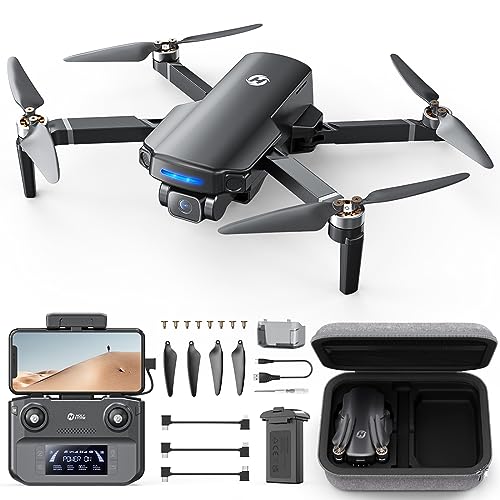
The HS720G features GPS-assisted flight and a 4K EIS camera. It includes a carrying case and extra battery. Beginners appreciate the simple controls and reliable return-to-home.
Weight 460 gFlight Time 26 minCamera 4K EISGPS Yes
- Beginner-friendly
- Comes with two batteries
- Stable hover
- Camera quality not top-tier
- No obstacle avoidance
Best for: best for beginners
DJI Air 3
★★★★★ 4.8 / 5 best for photography
The Air 3 has a dual-camera system with a 1-inch sensor and a 3x medium telephoto. It shoots 4K/60fps HDR video. Its 46-minute flight time leads the category.
Weight 720 gFlight Time 46 minCamera Dual 4K/60fpsObstacle Sensing Omnidirectional
- Outstanding camera versatility
- Long battery life
- Advanced obstacle avoidance
- Heavier and larger
- Higher price
Best for: best for photography
Autel Robotics EVO Nano+
★★★★★ 4.5 / 5 best for portability
The EVO Nano+ weighs under 249g but has a 50MP camera with a 1/1.28-inch sensor. It offers 28 minutes of flight time and GPS. Its foldable design fits in a pocket.
Weight Under 249 gFlight Time 28 minCamera 50MP, 4K/30fpsSensor 1/1.28-inch
- Compact and light
- High-resolution camera
- Good GPS performance
- No obstacle avoidance
- App interface could improve
Best for: best for portability
Ruko F11 Pro
★★★★★ 4.3 / 5 best budget
The F11 Pro is a budget GPS drone with a 4K camera and 30-minute flight time. It includes two batteries and a carrying case. Users find it stable and easy to control.
Weight 560 gFlight Time 30 min (per battery)Camera 4KGPS Yes
- Very affordable
- Good battery life
- Includes accessories
- Camera lacks gimbal stabilization
- Plastic build
DJI Mavic 3 Classic
★★★★★ 4.8 / 5 best for professionals
The Mavic 3 Classic features a 4/3 CMOS Hasselblad camera for exceptional image quality. It offers 46 minutes of flight time and omnidirectional obstacle sensing. Professionals rely on its precise GPS and advanced features.
Weight 895 gFlight Time 46 minCamera 4/3 CMOS HasselbladObstacle Sensing Omnidirectional
- Superb image quality
- Long flight time
- Robust build
Best for: best for professionals
Choosing the right GPS drone depends on your skill level and budget. Some prioritize camera quality, others battery life. Our picks cover all major decision branches.
What to Look For in a GPS Drone
GPS is essential for stable hovering and precise return-to-home. Look for a drone with GLONASS or Galileo support for better accuracy. Flight time matters; aim for at least 25 minutes. Camera quality depends on your needs, from 4K for hobbyists to Hasselblad for pros. Check obstacle avoidance for safety, especially if you are a beginner. Finally, consider weight, as drones over 250g may require registration.
GPS Accuracy and Features
GPS accuracy affects how well the drone holds position. Some drones use dual-frequency GPS for improved reliability. Return-to-home is a key safety feature that uses GPS to bring the drone back if signal is lost. Geofencing can prevent flying in restricted areas. Advanced models offer GPS-based waypoint navigation. Owners report that GPS performance varies, so read reviews for real-world accuracy.
Camera and Gimbal Considerations
A gimbal stabilizes the camera for smooth footage. Three-axis gimbals are standard on quality drones. Sensor size impacts low-light performance; larger sensors like 1-inch or 4/3 are better. Video resolution and frame rate matter; 4K at 60fps is common. Some drones have multiple cameras for zoom. For photography, look for RAW support and manual controls.
Battery Life and Charging
Flight time is a critical spec; most drones fly 25-35 minutes. Extra batteries extend your session but add cost. Charging time varies; some batteries fast-charge in 60 minutes. Consider the number of batteries included in the package. Battery health degrades over time, so factor replacement costs. Some drones offer intelligent battery management for longevity.
Portability and Build Quality
Foldable designs are easier to transport. Weight under 250g often avoids registration in many countries. Build materials range from plastic to magnesium alloy. Water resistance is rare but useful. Check the drone's size when folded; some fit in a pocket. Durability matters for crash resistance, but no drone is indestructible.
Questions people ask
What does GPS do on a drone?
GPS allows the drone to know its exact position. It enables stable hovering, precise return-to-home, and waypoint navigation. Without GPS, drones drift and are harder to control.
How accurate is GPS on drones?
Consumer drones typically achieve 1-2 meter accuracy. Dual-frequency GPS can improve this. Accuracy can be affected by weather, buildings, and satellite visibility.
Can a drone fly without GPS?
Yes, but it requires manual control and is more challenging. GPS assists with stability and safety features. Flying without GPS is possible in ATTI mode, but drift is common.
What is return-to-home (RTH)?
RTH uses GPS to bring the drone back to its takeoff point. It activates when signal is lost or battery is low. It's a crucial safety feature.
Do I need a license to fly a GPS drone?
In many countries, drones over 250g require registration. For commercial use, a license is often needed. Check local regulations before flying.
Which GPS drone is best for beginners?
The Holy Stone HS720G is user-friendly with GPS and simple controls. The DJI Mini 4 Pro is also easy but more expensive. Beginners should prioritize safety features.
How long do drone batteries last?
Most drones fly 25-35 minutes per battery. Factors like wind and payload reduce flight time. Buying extra batteries is recommended.
Can I use a drone in windy conditions?
GPS drones handle moderate wind, but strong winds can affect stability. Check the drone's wind resistance rating. Avoid flying in high winds.
What is the best GPS drone for photography?
The DJI Air 3 and Mavic 3 Classic excel in photography. They have large sensors and advanced features. For budget, the Potensic Atom offers good value.
Is a GPS drone worth the extra cost?
Yes, GPS significantly improves safety and ease of use. It prevents loss and enables advanced features. For most pilots, the investment is worthwhile.
The bottom lineSo which one?
The DJI Mini 4 Pro is the best overall for its combination of camera, safety, and portability. For budget buyers, the Potensic Atom 3 Axis offers great value. Beginners will appreciate the Holy Stone HS720G's simplicity.