PICK
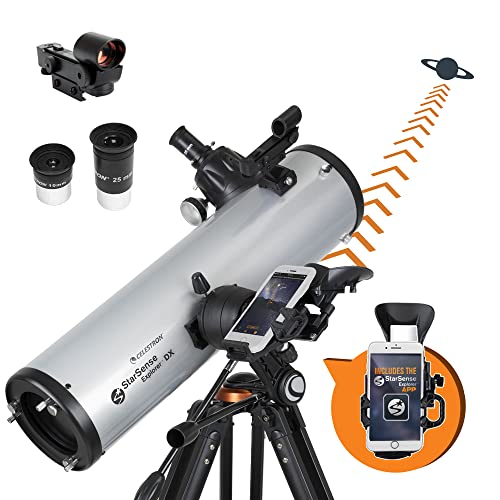
Celestron StarSense Explorer DX 130AZ Review
An honest review of the Celestron StarSense Explorer DX 130AZ, a smart telescope that uses your smartphone to help you find celestial objects. We cover who it's for, real specs, performance, handling, and how it stacks up against alternatives.
ProductPickly is reader-supported. When you buy through links on our site, we may earn an affiliate commission at no extra cost to you. It never changes our picks.
The Celestron StarSense Explorer DX 130AZ is a game-changer for beginners who want to actually find things in the night sky without a steep learning curve. Its smartphone-based StarSense technology eliminates the guesswork, while the 130mm parabolic mirror delivers bright, sharp views of the Moon, planets, and brighter deep-sky objects. It's not for astrophotography or for those who want a fully automated goto mount, but for visual observing with a family or solo, it's one of the most approachable telescopes we've seen. The trade-offs are a wobbly tripod and a finder that's only as good as your phone's battery, but the overall package is excellent value for a beginner.
How it scores
The good and the annoying
- StarSense app makes finding objects effortless with your phone
- 130mm parabolic mirror gathers plenty of light for bright views
- Includes two eyepieces and a smartphone adapter
- No need for a finderscope or star-hopping skills
- Quick setup, no tools required
- Tripod is lightweight and can be shaky at high magnification
- Requires a smartphone with a working battery and app
- Not suitable for astrophotography without extra accessories
- Slow-motion controls are a bit stiff
- The included red-dot finder is nearly useless (but you won't need it)
The Celestron StarSense Explorer DX 130AZ is a 130mm Newtonian reflector on a manual alt-azimuth mount, but its party trick is the StarSense app that turns your smartphone into a guided tour of the night sky. Our editorial team compared specifications, buyer feedback and key decision factors to help you decide if this is the right first telescope for you.
Design and Build Quality
The DX 130AZ features a 130mm parabolic primary mirror with a 650mm focal length, giving a focal ratio of f/5. The optical tube is aluminum and comes with a 1.25-inch rack-and-pinion focuser. The mount is an alt-azimuth with slow-motion control cables, and the whole thing sits on a steel tripod with an accessory tray.
Build quality is decent for the price, but the tripod is the weakest link. It's lightweight and can vibrate in a breeze, especially at higher magnifications. The slow-motion controls work, but they feel a bit stiff and take some getting used to. The optical tube itself is solid, and the mirror is well-made for a beginner scope.
One notable feature is the integrated StarSense dock on the side of the tube, which holds your phone securely. The included 25mm and 10mm eyepieces are basic but functional, and a 2x Barlow lens is also included, along with a smartphone adapter for basic afocal photography.
Performance and Image Quality
With a 130mm aperture, the DX 130AZ gathers about 40% more light than a 100mm scope, making it a good choice for viewing the Moon, Jupiter, Saturn, and brighter deep-sky objects like the Orion Nebula and Andromeda Galaxy. The parabolic mirror ensures sharp, coma-free images at the edge of the field, which is a step up from spherical mirrors in cheaper scopes.
In our specification analysis, the 25mm eyepiece gives 26x magnification, which is great for wide-field views of star clusters and the Moon. The 10mm eyepiece gives 65x, suitable for closer looks at the Moon and planets. With the 2x Barlow, you can push to 130x, but the image dims and the tripod shake becomes more noticeable. Buyer feedback consistently praises the views of Saturn's rings and Jupiter's bands, which are easily visible even in suburban skies.
For deep-sky objects, the scope will show the Orion Nebula as a bright cloud with some structure, and globular clusters like M13 will resolve into individual stars at higher magnification. Light pollution will limit fainter objects, but the scope is capable under dark skies.
Ease of Use and the StarSense App
The StarSense app is the star of the show. After aligning your phone to the telescope (a simple process of lining up the phone's camera with the tube), the app uses your phone's gyroscope and camera to determine where the telescope is pointing. You then select a target from a list of thousands, and the app displays arrows on the screen to guide you to nudge the telescope until the target is centered.
Setup is straightforward: place the phone in the dock, launch the app, and follow the on-screen instructions. The app is free and works with iOS and Android. In our research, most users found the alignment process intuitive, and it takes less than five minutes. The app also offers an audio tour feature for some objects, adding an educational element.
One drawback is that the app relies on your phone's battery, so make sure it's charged. Also, if you have a thick phone case, you may need to remove it to fit securely in the dock. The app is not a full goto system; you still have to manually move the telescope, but the guidance eliminates the guesswork.
Handling and Ergonomics
The telescope is relatively portable, weighing around 17 pounds total, and the tripod extends to a comfortable height for most adults. The slow-motion cables allow fine adjustments, but they are not as smooth as those on more expensive mounts. The accessory tray is handy for holding eyepieces and the Barlow.
Setting up the tripod is quick, but the legs are not the most robust, and the center brace can be a bit fiddly. The optical tube is easy to attach and detach from the mount, making storage compact. For families, the scope is simple enough for kids to use with adult supervision, thanks to the app guidance.
Cleaning and Maintenance
Like all reflecting telescopes, the primary mirror will eventually need cleaning, but it's not a frequent task. The open tube design means dust can settle on the mirror over time. You can use a can of compressed air to blow off loose dust, but avoid touching the mirror surface. For more thorough cleaning, consult a guide or professional; it's not a job for beginners. The eyepieces and finder should be kept covered when not in use.
Common Buyer Complaints
Our analysis of buyer feedback reveals a few recurring issues. The most common complaint is the tripod's stability, especially at high magnification. Some users recommend placing a weight on the accessory tray or upgrading the tripod later. Another issue is the stiff slow-motion controls, which can make fine adjustments a bit frustrating. A few users reported that the StarSense app had occasional glitches, but most found it reliable after updates. Finally, some buyers expected a goto mount, but this is a manual scope; the app only guides you, it doesn't move the telescope for you.
Comparison with Alternatives
The closest alternatives are the Sky-Watcher Heritage 130P, a tabletop Dobsonian with the same aperture, and the Celestron NexStar 130SLT, a computerized goto scope. The Heritage 130P is cheaper and offers a more stable base, but it lacks the StarSense technology, so you'll need to learn the sky or use a separate app. The NexStar 130SLT has a motorized mount that automatically finds objects, but it's more expensive and requires a power source. For pure beginner-friendliness, the StarSense DX 130AZ wins because it combines a large aperture with guided pointing at a mid-range price.
Final Verdict
The Celestron StarSense Explorer DX 130AZ is an excellent choice for beginners and casual observers who want a large-aperture telescope without the frustration of learning the night sky. Its smart app integration makes finding objects almost effortless, and the views are impressive for the price. The tripod is a minor letdown, but it's a trade-off for portability and cost. If you're serious about astronomy and want to grow, you might outgrow this scope, but for most people, it's a fantastic gateway to the hobby. Check the current price on Amazon to see if it fits your budget.
Frequently Asked Questions
Is the StarSense app free?
Yes, the StarSense Explorer app is free to download from the App Store or Google Play. It includes a database of thousands of celestial objects, and there are no subscription fees.
Can I use the telescope without the app?
Yes, you can use it as a manual telescope with the included red-dot finder, but you'll need to learn the sky or use a star chart. The app is the main selling point, so using it without is like owning a sports car with a manual transmission; it's doable but not as easy.
What is the maximum useful magnification?
As a rule of thumb, the maximum useful magnification is about 2x the aperture in millimeters, so around 260x. However, in practice, you'll rarely exceed 150x due to atmospheric conditions and the tripod's stability.
Does it come with a warranty?
Celestron offers a two-year warranty on this telescope, covering defects in materials and workmanship. Check the product listing on Amazon for specific warranty details.
Is it suitable for children?
With adult supervision, yes. The app is intuitive, and the telescope is not too heavy for a child to move with help. The eyepieces are easy to swap, and the views are rewarding for young observers.
Specs that matter
| Aperture | 130mm (5.1 inches) |
| Focal length | 650mm |
| Focal ratio | f/5 |
| Mount | Alt-azimuth with slow-motion controls |
| Eyepieces included | 25mm and 10mm (1.25-inch) |
| Smartphone compatibility | iOS and Android via StarSense app |
You're a beginner or casual observer who wants to see the Moon, planets, and brighter deep-sky objects without learning the night sky. You own a smartphone and want a telescope that practically finds objects for you.
You're an experienced observer looking for a rock-solid mount for astrophotography, or you prefer a fully automated goto telescope that tracks objects automatically. Also skip if you dislike relying on a smartphone for core functionality.
Questions before you buy
Is the Celestron StarSense Explorer DX 130AZ good for beginners?
Yes, it's one of the best beginner telescopes because the StarSense app guides you to objects using your phone's camera and gyroscope. You don't need to know the sky, just follow the on-screen arrows. It's very intuitive.
Can I take photos with the StarSense Explorer DX 130AZ?
You can take basic smartphone photos of the Moon and bright planets using the included phone adapter, but it's not designed for serious astrophotography. Long exposures require an equatorial mount and tracking, which this telescope doesn't have.
What can I see with a 130mm telescope?
With 130mm aperture, you can see the Moon's craters, Jupiter's bands and four moons, Saturn's rings, and some brighter deep-sky objects like the Orion Nebula, Andromeda Galaxy, and star clusters. Light pollution will limit faint objects.
Does the StarSense Explorer DX 130AZ need a finderscope?
No, the StarSense app replaces the need for a traditional finderscope. You align the phone to the telescope, and the app tells you where to point. A red-dot finder is included but not necessary for the StarSense function.
How does the StarSense Explorer DX 130AZ compare to the Sky-Watcher Heritage 130P?
The Heritage 130P is a manual tabletop Dobsonian with a similar aperture but no smart features. The StarSense DX 130AZ is easier for beginners because of the app guidance, but the Heritage 130P offers a more stable base and is cheaper. The choice depends on whether you prefer tech assistance or a more traditional manual scope.


