Binoculars Telescopes and Optics
Best Beginner Telescopes for Stargazing in 2026
7 picks compared
6 min read
ProductPickly is reader-supported. When you buy through links on our site, we may earn an affiliate commission at no extra cost to you. It never changes our picks.
The short answerThe Celestron StarSense Explorer DX 130AZ is the best overall for beginners, offering easy smartphone alignment. The Orion StarBlast II 4.5 EQ is a great value for its aperture. The Celestron PowerSeeker 127EQ is a solid budget choice.
?How we pickedWe compare published specifications, safety certifications and thousands of verified owner reviews, and we do not physically test every unit. Read the full process in our review methodology.
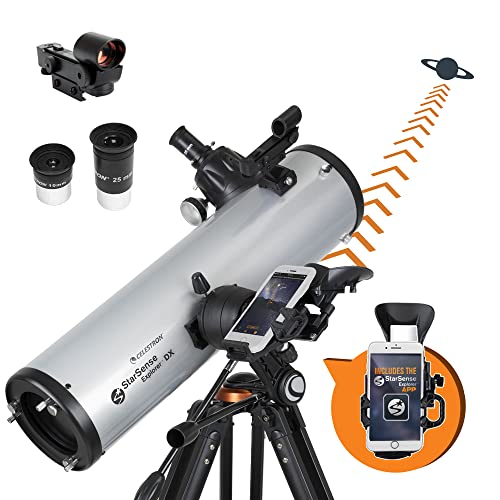
Celestron StarSense Explorer DX 130AZ
★★★★★ 4.7 / 5 Best Overall
This Newtonian reflector uses your smartphone to align and locate objects. The StarSense app guides you to thousands of targets. It has a 130mm aperture and a sturdy alt-azimuth mount.
Aperture 130mmFocal Length 650mmMount Alt-azimuthFocal Ratio f/5
- Easy to set up and use
- App-based object location
- Good light gathering for the price
- Requires a smartphone
- Tripod can be wobbly at high power
Orion StarBlast II 4.5 EQ
★★★★★ 4.6 / 5 Best Value
This 114mm reflector is compact and portable. It comes with an equatorial mount that tracks objects as Earth rotates. The tabletop design makes it easy to set up anywhere.
Aperture 114mmFocal Length 450mmMount EquatorialFocal Ratio f/3.9
- Great value for aperture
- Compact and portable
- Good for planetary and lunar views
- Tabletop base can be low for some users
- Equatorial mount has a learning curve
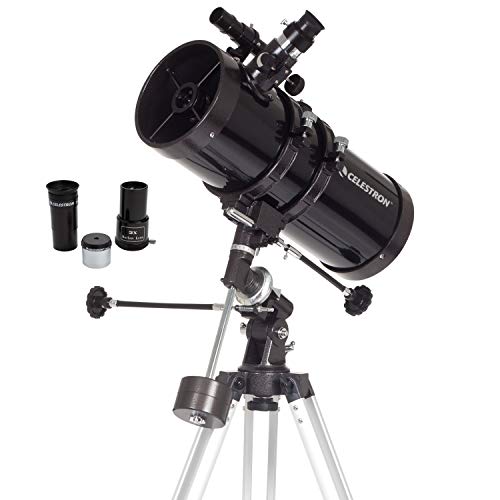
Celestron PowerSeeker 127EQ
★★★★★ 4.4 / 5 Best Budget
This 127mm reflector offers a large aperture at an affordable price. It includes two eyepieces and a finderscope. The equatorial mount allows for tracking, but it may require some patience to learn.
Aperture 127mmFocal Length 1000mmMount EquatorialFocal Ratio f/7.9
- Large aperture for the price
- Good for viewing faint objects
- Includes tripod and eyepieces
- Mount can be shaky
- Collimation needed frequently
Celestron AstroMaster 130EQ
★★★★★ 4.5 / 5 Best for Kids
This 130mm Newtonian reflector is designed for beginners, including younger users. It features a sturdy equatorial mount and a slow-motion control rod. The included StarPointer finderscope makes aiming easy.
Aperture 130mmFocal Length 650mmMount EquatorialFocal Ratio f/5
- Easy to aim with StarPointer
- Good aperture for viewing planets
- Stable mount
- Equatorial mount can be confusing for kids
- Tripod legs are not adjustable
Orion SkyQuest XT6 Classic Dobsonian
★★★★★ 4.8 / 5 Best for Deep-Sky
This 150mm Dobsonian reflector excels at showing faint deep-sky objects. The simple alt-azimuth mount is easy to use and very stable. It comes with two eyepieces and a finderscope.
Aperture 150mmFocal Length 1200mmMount DobsonianFocal Ratio f/8
- Excellent light gathering
- Simple and stable mount
- Great for galaxies and nebulae
- Large and bulky
- No motorized tracking
Best for: Best for Deep-Sky
Celestron NexStar 130SLT
★★★★★ 4.5 / 5 Best for Auto-Tracking
This 130mm reflector features a computerized GoTo mount. It can automatically locate and track over 4,000 objects. The hand controller is user-friendly for beginners.
Aperture 130mmFocal Length 650mmMount Computerized Alt-azimuthFocal Ratio f/5
- Automatic object finding
- Tracks objects smoothly
- Large database of celestial targets
- Requires power source
- Setup can be time-consuming
Best for: Best for Auto-Tracking
Gskyer Telescope 600x90mm
★★★★★ 4.3 / 5 Best for Portability
This 90mm refractor is lightweight and easy to carry. It comes with a tripod and multiple eyepieces. The alt-azimuth mount is simple to use, making it a good choice for travel.
Aperture 90mmFocal Length 600mmMount Alt-azimuthFocal Ratio f/6.7
- Very portable
- Easy to set up
- Good for terrestrial viewing
- Smaller aperture limits deep-sky views
- Tripod can be flimsy
Best for: Best for Portability
We compared specifications, owner feedback, and use-case fit. We focused on scopes that are easy to set up and use, with enough aperture to show you real detail.
Aperture and Light Gathering
Aperture is the diameter of the main lens or mirror. It determines how much light the telescope collects. More light means you can see fainter objects and more detail. For beginners, an aperture of 70mm to 130mm is a good range. Larger apertures are heavier and more expensive. Start with the largest aperture you can afford and carry.
Mount Types: Alt-Azimuth vs Equatorial
Alt-azimuth mounts move up and down and side to side. They are simple and intuitive, making them great for beginners. Equatorial mounts are tilted to match Earth's axis. They allow tracking by turning one knob, but they have a learning curve. Dobsonian mounts are a type of alt-azimuth that is very stable and easy to use. Choose a mount that you feel comfortable using.
Refractor vs Reflector vs Compound
Refractors use lenses and are low-maintenance. They are good for planetary and lunar views. Reflectors use mirrors and offer larger apertures for less money. They are excellent for deep-sky objects. Compound scopes use both lenses and mirrors, offering a compact design. Each type has pros and cons. Reflectors are often the best value for beginners.
Key Accessories for Beginners
Most telescopes include eyepieces and a finderscope. A good eyepiece can make a big difference. Consider a low-power eyepiece for wide views and a high-power one for planets. A red dot finder or a smartphone adapter can help you locate objects. A moon filter reduces glare when viewing the moon. Start with what's included and upgrade as you learn.
Questions people ask
What is the best telescope for a beginner?
The Celestron StarSense Explorer DX 130AZ is often recommended. It has a large aperture and uses your smartphone to help you find objects. It's easy to set up and use, making it ideal for beginners.
How much should I spend on a first telescope?
You can find decent telescopes for under For a good balance of quality and features, plan to spend between and More expensive telescopes offer better optics and mounts, but they may be overkill for a beginner.
Is a Dobsonian telescope good for beginners?
Yes, Dobsonians are excellent for beginners. They are simple to use, stable, and offer large apertures for the price. The Orion SkyQuest XT6 is a great example.
What can I see with a beginner telescope?
With a 70mm to 130mm telescope, you can see the Moon's craters, Jupiter's moons, Saturn's rings, and bright deep-sky objects like the Orion Nebula. You can also see star clusters and double stars.
How do I choose between a refractor and a reflector?
Refractors are more portable and require less maintenance. Reflectors offer larger apertures for less money. If you want to see faint objects, a reflector is better. If you want a grab-and-go scope, a refractor might be easier.
What does focal length mean in a telescope?
Focal length is the distance light travels from the lens or mirror to the focus point. A longer focal length gives higher magnification with a given eyepiece. It also affects the field of view. For beginners, a focal length between 600mm and 1200mm is common.
Do I need a motorized telescope?
Motorized mounts can automatically find and track objects. They are convenient but add cost and complexity. For a beginner, a manual mount can be just as rewarding. You learn the sky better by finding objects yourself.
Can I use a telescope for bird watching?
Yes, refractors are often used for terrestrial viewing. They provide upright images, unlike reflectors. However, telescopes have a narrow field of view, so binoculars are usually better for birding. If you want a dual-purpose scope, consider a spotting scope.
The bottom lineSo which one?
For most beginners, the Celestron StarSense Explorer DX 130AZ offers the best combination of ease and performance. If you're on a tight budget, the Celestron PowerSeeker 127EQ is a solid choice. Consider your priorities and choose accordingly.