Baby-proofing a home usually starts with the outlets, and for good reason: curious toddlers love to poke and plug. This roundup collects outlet covers that are easy to buy today and simple to live with, from push-in plug caps that fill empty sockets to a sturdy duplex wall plate for a tidy finish. Our picks are drawn only from current product listings, so every detail below reflects what each maker states rather than any claim of our own hands-on use. We kept the focus on honest fit, pack size, and how hard each cover is for a child to remove while still being manageable for an adult. Outlet covers are a helpful layer, not a substitute for supervision, and we say so throughout.
How we chose these outlet covers
We compared listings for child-proof outlet products in the baby and safety category and grouped them by what they actually do. Most are push-in plug caps that seal unused sockets; one is a standard duplex wall plate you screw over an outlet for a clean, solid cover. For each option we noted the pack count, the stated fit for standard outlets, and how the maker describes installation and removal. We did not install, measure, or stress these items ourselves, so nothing here is a performance verdict. Instead, we matched each cover to a clear job: a top all-rounder, a bulk buy, a discreet clear look, a hard-to-remove design, a wall plate, and a smaller pack for travel.
Our picks
Babepai 38-Pack: our top all-rounder
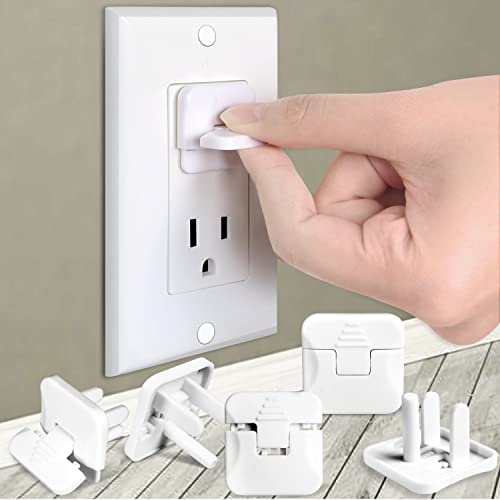
The Babepai set is a large pack of white push-in plug caps aimed at child-proofing, and the listing pitches an improved design for a snug hold. Thirty-eight caps is enough to cover the open sockets in several rooms, which makes it a sensible starting point for a first baby-proofing pass. As push-in caps, they fill an empty outlet so little fingers and objects meet a smooth face instead of the slots. Keep in mind that any removable cap can be worked loose over time, so plan to check them and keep spares out of reach. For most families wanting a simple, widely available option, this is the one we would reach for first.
Safety 1st 72-Pack: best for a whole home
Safety 1st is a long-running name in baby gear, and this 72-count box is built for covering an entire house in one go. If you have outlets in every room plus hallways and a basement, a high pack count saves repeat orders and leaves spares for the ones that inevitably go missing. The caps are the familiar push-in style in white, sized for standard outlets per the listing. A bigger box is only an advantage if you will use them, so match the count to your real outlet tally rather than over-buying.
ENERLITES 10-Pack Wall Plate: best for a clean cover
This ENERLITES option is different from the plug caps: it is a standard duplex wall plate, the faceplate that screws over an outlet. A fresh, well-fitted plate covers the box and the wiring edges and gives a tidy, solid surface, and ten plates is handy if you are refreshing covers around the home. Be clear on what a faceplate does and does not do: on its own it does not block the socket holes, so it is not a child-proofing cap by itself. Think of it as the plate you pair with plug caps, or the base you would swap for a dedicated sliding self-closing cover if that is the route you prefer.
Clear Outlet Covers 50-Pack: best discreet look
If you would rather the covers disappear against the wall, this 50-pack of clear push-in caps is the pick. Clear plastic blends in better than bright white on many walls and plates, which some parents prefer in living rooms and bedrooms. Fifty caps is a generous count that covers a home with room to spare. Like all push-in caps, they rely on a friction fit, so seat them firmly and keep an eye on any that loosen. The listing describes them as sturdy and designed for standard outlets.
Mom's Choice 45-Pack with Hidden Pull Handle: best hard-to-remove design
These caps add a hidden pull handle on the back, a design meant to be easy for an adult to grip and remove while staying flush and tricky for a toddler to pry out. The listing notes a Mom's Choice award and a 45-count pack with a 3-prong style. The appeal is the balance many parents want: covers that you can take out quickly to use the outlet, yet do not present an obvious edge for small fingers. As with any cap, supervision still matters, and a removed cap should never be left within a child's reach.
Safety 1st 36-Count: best smaller pack for travel
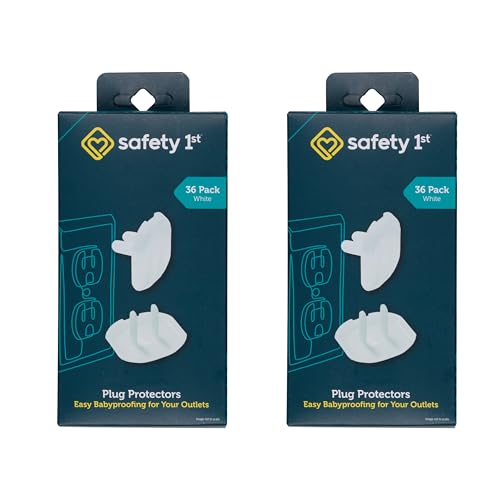
Sometimes you do not need dozens of caps, you need a handful for a diaper bag, a rental, or a trip to the grandparents. The 36-count Safety 1st box is the same trusted push-in style in a more modest quantity, so you can keep a few on hand without a giant box. Toss a small bag of caps in your travel kit and you can cover the outlets near where your child will be playing. Standard-outlet fit is a listing claim, so confirm the outlet style wherever you are staying.
How to choose outlet covers
There are three common types, and they solve the problem in different ways. Push-in plug caps are the small inserts that fill an empty socket; they are inexpensive, come in big packs, and install in seconds with no tools. Self-closing plates replace the faceplate and use a sliding cover that snaps shut when a plug is removed, so there is no loose piece to misplace. Box covers are larger enclosures that wrap around a plug that stays in place, useful for cords you do not want unplugged. Many homes end up using a mix.
The biggest honest tradeoff with plug caps is the loose-piece problem. A cap a child manages to pull out becomes a small object that can be a choking hazard if it is left on the floor. That is why many parents favor self-closing plates in rooms where a toddler spends unsupervised minutes, and why any removed cap should go straight into a drawer, not a pocket or a low shelf.
Fit matters too. These covers are described for standard duplex receptacles, the common two-socket outlet in most homes. Odd outlets, decora-style faces, or GFCI units may need a different plate or cap, so check before buying in bulk. Ease of use cuts both ways: you want a cover hard enough that a child cannot remove it, but easy enough that you are not fighting it every time you vacuum or charge a phone. Hidden-handle caps and self-closing plates both aim at that middle ground.
Finally, count and install. Walk the house and tally the open sockets before you choose a pack size; a 36 or 38 pack suits a small home, while 50 to 72 covers a larger one with spares. Plug caps need no tools. A wall plate needs a screwdriver and the power treated with care, so if wiring is involved and you are unsure, bring in a qualified electrician.
A note on safety
Outlet covers can reduce the risk of outlet-related injuries, but they are a supervision aid, not a guarantee. No cover replaces an adult watching a curious child. Push-in caps can become a choking hazard if a child removes one and it is left out, which is a reason many families prefer self-closing plates. Keep every cover seated and in place, store spare caps out of reach, and keep supervising. We make no safety guarantees, and you should treat any single product as one layer among several.
The bottom line
For most families, a large pack of push-in caps like the Babepai 38-pack is the simplest first step, with a bigger Safety 1st box when you are covering a whole home. Choose the clear 50-pack if you want the covers to blend in, the hidden-handle set if removal is a daily chore, and a solid wall plate for a clean finish. Whatever you pick, keep it in place and keep watching.