Radar Detectors
Best Radar Detectors for Long-Range Alerts and Compact Builds
7 picks compared
9 min read
ProductPickly is reader-supported. When you buy through links on our site, we may earn an affiliate commission at no extra cost to you. It never changes our picks.
The short answerThe best radar detector for most drivers is the Uniden R7, because its dual antennas give long warning front and rear, the directional arrows point to the signal source, and built-in GPS mutes the fixed false sources you pass every day. If you want flagship range for less, the Uniden R3 keeps the reach with fewer extras, the Escort Redline 360c is the premium pick with WiFi updates, and the Cobra RAD 480i adds an app link at a mid-range outlay. The chosen picks below span long-range flagships, GPS units with lockouts and compact budget builds, so you can match a detector to your driving. Rules vary by area, so confirm a detector is legal where you drive.
?How we pickedWe compare published specifications, safety certifications and thousands of verified owner reviews, and we do not physically test every unit. Read the full process in our review methodology.
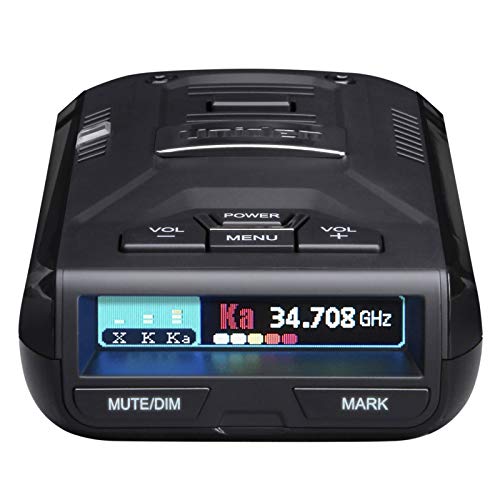
Uniden R7 Extreme Long-Range Laser Radar Detector
★★★★★ 4.7 / 5 Editor's pick
The R7 runs two antennas, one facing forward and one facing rear, so it gives long warning on the open highway and shows an arrow for where the signal is coming from. Built-in GPS lets it remember and mute the fixed sources you pass every day, which is why it is our overall pick for drivers who want range and clear direction in one unit.
Antennas Dual, front and rearDirection Directional arrowsGPS Built-in with lockoutsBands X, K, Ka, laser
- Dual antennas give long warning and rear coverage
- Directional arrows point to the signal source
- GPS lockouts cut repeat alerts on known spots
- One of the larger units on the windshield
- Takes some menu time to set up the way you want
Best for: Highway drivers who want maximum range plus arrows showing where the signal is.
Uniden R3 Long-Range Laser Radar Detector with GPS
★★★★★ 4.6 / 5 Best long-range value
The R3 keeps the long reach that made this line popular but uses a single antenna and drops the directional arrows, which brings the size and the outlay down. Built-in GPS with mute memory means it learns the spots you want silenced, so it is a strong choice for anyone who wants serious range without every extra feature.
Antennas SingleGPS Built-in with mute memoryDisplay Multi-color OLEDBands X, K, Ka, laser
- Long detection range from a smaller body
- GPS mute memory quiets the places you pass daily
- Clear OLED readout with voice alerts
- No directional arrows or rear antenna
- Needs occasional firmware updates over USB
Best for: Drivers who want flagship range but can skip the arrows to save space and money.
Escort Redline 360c Plug and Play Radar Detector
★★★★★ 4.6 / 5 Best premium
The Redline 360c pairs extreme range with directional arrows and built-in WiFi, so it can update its database and shared alerts without being tethered to a computer. It sits at the top of the price ladder, but the auto updates and 360 degree awareness make it the pick for drivers who want the detector to stay current on its own.
Antennas Dual, front and rearDirection 360 directional arrowsUpdates Built-in WiFiGPS Lockouts and alerts
- Extreme range with full directional arrows
- Built-in WiFi keeps the database current on its own
- Connects to shared alert network through the app
- Sits at the highest end of the range
- App and account setup add a few steps
Best for: Shoppers who want top range and arrows with updates handled over WiFi.
Cobra RAD 480i Laser Radar Detector with Bluetooth
★★★★★ 4.4 / 5 Best with app
The RAD 480i connects over Bluetooth to Cobra's app, which layers in community alerts and over-the-air database updates on top of the detector's own warnings. Its filtering is built to cut the collision-avoidance noise from newer cars, so it is a sensible mid-range pick for commuters who like having a phone app in the loop.
App iRadar over BluetoothFilter IVT false alert filterAlerts Voice, red light, cameraBands X, K, Ka, laser
- App adds community alerts and easy updates
- Filter targets false hits from newer vehicles
- Voice alerts keep your eyes on the road
- Range trails the flagship Uniden and Escort units
- Best features lean on keeping the phone app running
Best for: Commuters who want app-linked alerts and updates at a mid-range outlay.
Cobra RAD 350 Compact Laser Radar Detector
★★★★★ 4.3 / 5 Best budget
The RAD 350 strips things back to the basics with long-range detection and a false alert filter, but no GPS and no app pairing. That keeps it simple and affordable, so it works as a first detector or a spare for a second car where you just want a straightforward heads-up.
Detection Long range LaserEyeFilter False alert filterGPS NoneBands X, K, Ka, laser
- Simple setup with no account or app needed
- Compact body is easy to move between cars
- Covers the common bands at a low outlay
- No GPS means it cannot lock out known false sources
- Shorter range than the GPS flagships
Best for: First-time buyers or a spare car who want a plain, low-cost alert.
Cobra RAD 700i Premium Laser Radar Detector
★★★★★ 4.5 / 5 Best Cobra range
The RAD 700i sits at the top of Cobra's lineup with longer reach, built-in GPS and the same iRadar app link as the 480i. It gives Cobra loyalists a step up in range and lockout features without moving to a different brand, which makes it the pick inside this family for drivers who want more than the mid-range model.
Detection Premium long rangeApp iRadar over BluetoothGPS Built-in lockoutsBands X, K, Ka, laser
- Longer range than the mid-range Cobra models
- GPS lockouts silence repeat false sources
- App adds shared alerts and updates
- Still trails the top Uniden and Escort flagships on raw range
- Fuller feature set means a longer first setup
Best for: Cobra fans who want the brand's longest range with GPS lockouts.
360 Degree Compact Radar Detector for Cars
★★★★★ 4.2 / 5 Budget alternative
This compact unit covers the main bands with 360 degree detection and voice alerts at an entry-level price, aimed at drivers who want a simple warning without a big brand outlay. It is a lesser-known maker, so treat it as a basic alternative rather than a match for the proven flagships, and check recent buyer feedback before you commit.
Detection 360 degreeDisplay LED readoutAlerts Voice and toneBands X, K, Ka, laser
- Low outlay for a first detector
- Compact size fits a small windshield footprint
- Voice and tone alerts in one small unit
- Lesser-known brand with a shorter track record
- No GPS lockouts to filter repeat false alerts
Best for: Bargain hunters who want a basic alert and will accept a smaller brand.
The best radar detector is the one that matches how and where you drive. If you want a single answer, a long-range flagship with GPS such as the Uniden R7 gives the most warning and the fewest false alerts for most drivers, while a compact unit covers a spare car or a first detector on a budget. The picks below span long-range flagships, GPS models with lockouts and simple compact builds, so you can weigh range, filtering and features against the price instead of settling for a shape that does not fit your routine.
Long-range flagships vs compact detectors
Long-range detectors, usually the larger flagship units, are built to pick up a signal from as far ahead as possible, and the best of them add a second antenna for rear coverage and directional arrows so you know whether the source is in front, behind or to the side. That extra warning time and context is the main reason drivers who spend hours on open highways pay more for a top unit. Compact detectors give up some of that reach and most of the advanced features in exchange for a smaller body and a lower price, which is a fair trade for a second car, a short commute or a first detector where a plain heads-up is enough. Decide how much highway you drive and how much warning you actually want, then match the size of the unit to that rather than to the spec sheet alone.
GPS lockouts and false-alert filtering
The single biggest difference between a detector you keep and one you switch off is how it handles false alerts. Everyday driving is full of harmless signals, from automatic door openers at stores to the collision-avoidance and blind-spot radar built into many newer cars, and a detector with no filtering will chirp at all of them until you stop trusting it. GPS is the feature that fixes this best, because a unit with GPS can remember a fixed source at an exact location and automatically mute that spot on every future pass, so you keep the real warnings and lose the repeat nuisance ones. On top of that, modern filtering modes recognize the signatures of common in-car radar, and app-linked models can share and receive reports from other drivers. If quiet, trustworthy alerts matter to you, a GPS model with good filtering is worth the step up from a basic unit.
Band coverage and what to look for
A radar detector is only useful if it covers the right bands, so check the spec before anything else. A capable unit detects the X, K and Ka radar bands plus laser, and Ka band matters most because a large share of current enforcement equipment uses it. The older X and K bands still appear, but a detector that lists only those and skips Ka or laser is a poor buy today. Laser is harder for any detector to catch early because it is a narrow beam, so treat laser detection as a late warning rather than a long one, and do not assume any unit will give you the same lead time on laser that it gives on radar. When you compare models, make sure Ka and laser are both on the list, and favor units that let you turn off bands you do not need to cut false alerts further.
Apps, updates and local rules
Connected detectors get more out of their hardware over time. App-linked models over Bluetooth or WiFi can refresh their database, share community alerts and warn about the locations of known fixed cameras, while GPS units without an app still take occasional firmware updates over USB to stay current. Simple budget detectors run entirely on their own with no app and no updates, which keeps them easy but means they never learn anything new. The most important point, though, is legal rather than technical. Radar detector rules vary by area, and in some places or vehicle types they are restricted or banned outright, so confirm the law where you drive before you fit one. A detector is a driving aid for awareness, not a license to speed, and the responsibility for staying within the limit and the law is always yours.
Questions people ask
What is the best radar detector for most drivers?
For most drivers the Uniden R7 is the best all round choice, because its dual antennas give long warning front and rear, the directional arrows show where the signal is coming from, and built-in GPS lets it mute the fixed sources you pass every day. If you want flagship range for less, the single antenna Uniden R3 covers the same core job with fewer extras.
Are radar detectors legal?
Laws vary by place, so you should confirm the rules where you drive before using one. In the United States radar detectors are legal for passenger vehicles in most states, but they are banned in some areas, restricted in commercial vehicles over a set weight, and not allowed on military bases, and other countries have their own rules. Treat any detector as a tool you must use within your local law.
What is the difference between long-range and compact radar detectors?
Long-range detectors, usually the larger flagship units, pick up signals from farther away and often add dual antennas, GPS and directional arrows for more warning and context. Compact detectors trade some of that reach and features for a smaller body and a lower price, which suits a spare car or a first detector where a basic heads-up is enough.
Do I need GPS and lockouts in a radar detector?
GPS is not essential, but it is the feature that most cuts down nuisance alerts over time. A detector with GPS can remember a fixed source, such as a store door opener or a stationary sensor, and automatically mute that exact spot on future passes, so you hear fewer false warnings and pay more attention to the real ones.
How do radar detectors reduce false alerts?
Modern detectors use filtering modes that recognize the signatures of common false sources, including the collision-avoidance and blind-spot radar built into many newer cars. Units with GPS add location-based lockouts that silence a source you choose at a set place, and app-linked models can share and receive community reports to flag what is ahead.
What radar bands should a detector cover?
A capable detector covers the X, K and Ka radar bands plus laser, since those cover the equipment in common use. Ka band in particular matters because much current enforcement radar uses it, so make sure any unit you choose lists Ka and laser detection rather than only the older X and K bands.
Do radar detectors need an app connection or updates?
Not all do, but the connected models get the most out of updates. App-linked detectors over Bluetooth or WiFi can refresh their database and share alerts, while GPS units without an app still benefit from occasional firmware updates over USB. Simple budget detectors run on their own with no app and no updates at all.
Can a radar detector detect speed cameras and red light cameras?
Detectors with GPS can warn you about the locations of known fixed speed cameras and red light cameras stored in their database, which is separate from sensing live radar. That database needs to stay current through updates to be useful, and coverage depends on the maker, so a non-GPS detector will not provide these camera location alerts.
The bottom lineSo which one?
For a radar detector that covers most drivers, the Uniden R7 is our pick because its dual antennas, directional arrows and built-in GPS give long warning and clear context in one unit. If you want flagship range for less, the Uniden R3 drops the arrows to save space and money, while the Escort Redline 360c is the premium choice with WiFi updates handled on its own. The Cobra RAD 480i suits commuters who like an app in the loop, the RAD 700i is the top Cobra for range and lockouts, and the compact RAD 350 or the entry-level 360 unit cover a spare car on a budget. Match the range and features to how you drive, and always confirm that a detector is legal where you use it.