Car Chargers
Best Car Chargers: USB-C and Multi-Port Picks
6 picks compared
7 min read
ProductPickly is reader-supported. When you buy through links on our site, we may earn an affiliate commission at no extra cost to you. It never changes our picks.
The short answerFor most people the Anker 167.5W 3-port USB-C charger is the best car charger here, because it pairs a trusted brand with three ports and a high shared power ceiling in an ultra-compact body. The Anker 40W 2-port is the simpler value pick for two phones, while the dual PD 100W unit is the max-power choice that can feed a USB-C laptop from a single 100W port. The LISEN 84W and SUPERONE 99W build in retractable cables so you carry fewer cords, and the Alanph 6-in-1 adds a voltmeter and extra ports. Match the port count and the wattage to the devices you actually charge in the car.
?How we pickedWe compare published specifications, safety certifications and thousands of verified owner reviews, and we do not physically test every unit. Read the full process in our review methodology.
Anker 167.5W Max 3-Port Ultra-Compact USB C Fast Charging Car Charger
★★★★★ 4.7 / 5 Editor's pick
Anker lists this as a 167.5W max, 3-port ultra-compact USB-C car charger, which is why we chose it as our top overall pick. That headline figure is a shared maximum across the three ports, so one device can draw the most while three devices split the budget.
Ports 3 (listed)Max power 167.5W max, shared (listed)Type USB-C fast charging (listed)Size Ultra-compact (listed)
- From Anker, a long established charging brand
- 167.5W max across 3 ports, per the listing
- Ultra-compact body for a tidy 12V socket
- The 167.5W is a shared ceiling, not per port
- No voltmeter or display listed
Best for: A compact, high-power 3-port charger from a trusted brand.
Anker 40W 2-Port PowerIQ 3.0 USB C Fast Charging Car Charger
★★★★★ 4.6 / 5 Value pick
Anker lists this as a 40W 2-port car charger with PowerIQ 3.0 and a USB-C port, making it our simple value pick for phones and earbuds. The 40W is the combined ceiling for both ports, so it suits two phones rather than a power-hungry laptop.
Ports 2 (listed)Max power 40W, shared (listed)Tech PowerIQ 3.0 (listed)Type USB-C port (listed)
- Simple 2-port layout, per the listing
- PowerIQ 3.0 for compatible fast charging
- Compact and from a known brand
- 40W is the combined ceiling for both ports
- Not enough for a power-hungry laptop
Best for: Charging two phones simply without overpaying on power.
USB C Car Charger Fast Charging 200W, Dual PD 100W Type C Car Charger,
★★★★★ 4.5 / 5 Max power
This listing is a dual-port USB-C car charger rated at 200W total with each PD port listed at 100W, so we chose it as the max-power pick. A single 100W port can feed many USB-C laptops, though drawing full power from both at once depends on what your 12V socket supplies.
Ports 2 USB-C (listed)Max power 200W total (listed)Per port PD 100W each (listed)Type USB-C PD (listed)
- Two USB-C PD ports listed at 100W each
- 200W total headline, per the listing
- A single 100W port suits many laptops
- Full 200W depends on your 12V socket
- No display or voltmeter listed
Best for: Powering a USB-C laptop from a 100W PD port in the car.
LISEN Retractable Car Charger, 84W Car Charger USB C Fast Charge, 4 in 1
★★★★★ 4.4 / 5 Built-in cables
LISEN lists this as an 84W, 4-in-1 retractable car charger with built-in cables for USB-C fast charging, so we picked it for people tired of loose cords. The retractable leads mean fewer cables to lose, and the 84W is the shared ceiling across its connectors.
Power 84W (listed)Design 4-in-1 retractable (listed)Cables Built-in (listed)Type USB-C fast charge (listed)
- Built-in retractable cables, per the listing
- 84W for USB-C fast charging
- 4-in-1 design means fewer loose cords
- 84W is shared across the connectors
- Built-in cables cannot be replaced if worn
Best for: Drivers who want built-in cables instead of loose cords.
Retractable Car Charger, SUPERONE 99W Car Phone Charger with Dual Cables
★★★★★ 4.3 / 5 Retractable
SUPERONE lists this as a 99W car charger with two retractable cables, which is why we chose it for charging without extra cords. The two built-in leads keep things tidy, and the 99W figure is split between whatever you plug in at once.
Power 99W (listed)Cables Dual, retractable (listed)Design Built-in leads (listed)Type Car charger (listed)
- Two retractable cables keep the cabin tidy
- 99W figure, per the listing
- Fewer loose cords to manage
- 99W splits across whatever you plug in
- Built-in cables cannot be swapped out
Best for: Keeping the cabin tidy with two retractable cables.
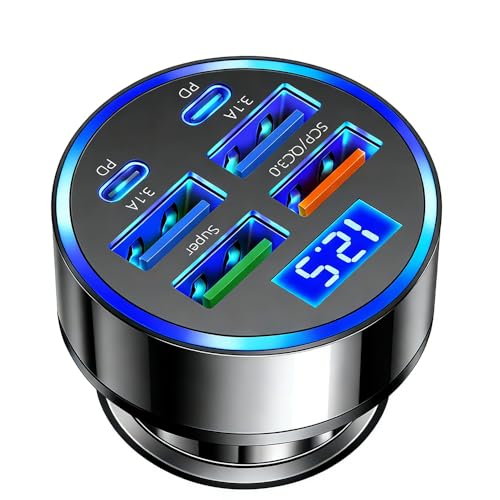
Alanph USB C Car Charger Adapter with Voltmeter Compatible with iPhone, Super+ QC3.0 6 in 1 Multi-Port Super Fast Charging Cigarette Lighter USB Charger for Android, Samsung
★★★★★ 4.2 / 5 Voltmeter
Alanph lists this as a QC3.0 6-in-1 multi-port cigarette-lighter charger with a built-in voltmeter, so we chose it for drivers who want a battery readout. The listing does not state a total wattage, and the voltmeter shows your car's voltage rather than charge speed.
Ports 6-in-1 multi-port (listed)Tech QC3.0 (listed)Display Voltmeter (listed)Max power Not stated
- Built-in voltmeter display, per the listing
- 6-in-1 multi-port layout
- QC3.0 fast charging support
- Listing does not state a total wattage
- Voltmeter shows voltage, not charge speed
Best for: Drivers who want a voltage readout and many ports.
The best car charger is the one whose ports, power and fit match the devices you plug in and the 12V socket in your dashboard, so that is what we focus on here. Every pick is a genuine wired USB or USB-C cigarette-lighter car charger, and we only quote the ports, wattage, standard and display each listing actually states. The lineup runs from a simple 2-port unit to a dual 100W PD charger, with high-power multi-port options and two retractable-cable models, and we flag where a listing stays silent rather than guessing.
USB-C PD versus USB-A QC
Fast charging comes in two main flavors, and getting this right decides how quickly your device fills. USB-C Power Delivery, or PD, is the standard modern phones, tablets and USB-C laptops use, and it can negotiate higher wattages for larger devices over a USB-C port. USB-A Quick Charge, or QC, is the older standard that runs over the rectangular USB-A port and remains common on many Android phones. On this list the Anker 167.5W, Anker 40W and the dual PD 100W unit lead with USB-C PD, while the Alanph pick is listed with QC3.0 across its multi-port layout. Your device and the cable you use decide which standard actually kicks in, so a USB-C PD laptop needs a PD port and a matching USB-C cable to reach full speed.
Single versus multi-port
How many ports you need comes down to how many devices ride with you. A 2-port charger like the Anker 40W or the dual PD 100W unit covers a driver and one passenger, and keeps things simple. Step up to the Anker 167.5W three-port or the Alanph 6-in-1 and you can charge a phone, a tablet and more at once, which suits a full car or a family. The trade-off is that more ports share a single power budget, so a crowded charger charges each device more slowly than one device alone. Count the devices you realistically charge together, then pick a port count with a little headroom rather than the most ports you can find.
Wattage and shared-power splitting
Wattage is where listings can mislead if you read only the headline. Most multi-port chargers advertise a total maximum that is shared across the ports, not delivered in full to each one, so the Anker 167.5W lists that figure as a shared ceiling across three ports. The dual PD 100W unit is the exception here, since its listing rates each port at 100W, though pulling the full 200W from both at once still depends on what your 12V socket can supply. A higher number only charges faster up to what your device accepts, so a phone that tops out near 30W gains nothing from a 200W charger. Buy the wattage for your largest device and for how many things you charge together, and read the per-port figures whenever several devices share one charger.
Fit in the 12V socket and extras
A car charger only helps if it fits and stays powered. These picks are built for the standard 12V accessory socket, often called the cigarette-lighter socket, so check whether yours stays live with the engine off and whether a compact or a longer body suits the socket position in your dashboard. The ultra-compact Anker sits nearly flush, while the LISEN 84W and SUPERONE 99W add built-in retractable cables that take a little more room but save you carrying loose cords. The Alanph pick adds a voltmeter that reads your battery voltage, which works as a rough battery gauge rather than a charging-speed meter. Built-in cables keep the cabin tidy but cannot be swapped if they wear, whereas open ports let you use whatever cable your device needs, so weigh tidiness against flexibility before you choose.
Questions people ask
Which car charger should most people buy?
For most people the Anker 167.5W 3-port USB-C charger is the best all round pick here, because it pairs a trusted brand with three ports and a high shared power ceiling in an ultra-compact body. If you only ever charge two phones, the Anker 40W 2-port is the simpler value choice, while the dual PD 100W unit is the one to reach for when a USB-C laptop needs feeding. The LISEN 84W and SUPERONE 99W both build in retractable cables so you carry fewer cords, and the Alanph 6-in-1 adds a voltmeter and extra ports. Match the port count and power to the devices you actually charge in the car before anything else.
What is the difference between USB-C PD and USB-A QC?
USB-C Power Delivery, or PD, is the standard most modern phones, tablets and laptops use for fast charging over a USB-C port, and it can negotiate higher wattages for larger devices. USB-A Quick Charge, or QC, is an older fast-charge standard that runs over the rectangular USB-A port and is common on many Android phones. On this list the Anker and dual PD units lead with USB-C PD, while the Alanph pick is listed with QC3.0 over its multi-port layout. Your device and its cable decide which standard actually kicks in, so a USB-C PD laptop needs a PD port and a USB-C cable to charge at full speed.
Does a higher wattage mean faster charging?
Only up to the point your device can accept. A phone that tops out around 25W to 30W will not charge any faster from a 200W charger than from a 40W one, because it only pulls what it is rated for. Higher wattage matters when you charge power-hungry devices like USB-C laptops or tablets, or when several devices share one charger at once. So pick the wattage for your biggest device and for how many things you charge together, not for the largest number on the box.
Why does the total wattage split across ports?
Most multi-port car chargers advertise a total maximum, and that budget is shared among the ports rather than delivered in full to each one. The Anker 167.5W, for example, lists 167.5W as a shared ceiling across its three ports, so one device can draw a large share while three devices together cannot exceed the total. The dual PD 100W unit is the exception on this list, since the listing rates each port at 100W, though pulling the full 200W at once still depends on what your car can supply. When you plan to charge several devices together, read the per-port figures, not just the headline total.
Can a car charger charge a laptop?
Many USB-C laptops charge from a car charger if it has a USB-C PD port with enough wattage. The dual PD 100W pick on this list rates each port at 100W, which covers a large share of USB-C laptops, and the Anker 167.5W can deliver a high share to a single port from its shared budget. You still need a USB-C to USB-C cable rated for the power, and the laptop has to accept USB-C charging in the first place. Older laptops with a barrel plug will not charge from these without a separate adapter.
Will these fit any car's 12V socket?
They are designed for the standard 12V accessory socket, often called the cigarette-lighter socket, which most cars and many trucks have. The main things to check are whether the socket stays powered when the engine is off, since some only work with the ignition on, and whether a compact or a longer body suits the socket's position in your dashboard. The ultra-compact Anker sits flush, while units with built-in retractable cables take up a little more room around the socket. If your vehicle uses a different accessory outlet, confirm it accepts a standard 12V plug before buying.
What does the voltmeter display do?
A voltmeter, like the one listed on the Alanph pick, shows your car battery's voltage on a small screen on the charger. It is a rough health readout: a healthy 12V battery typically reads higher with the engine running and lower at rest, so a consistently low number can hint at a weak battery or charging system. It does not show how fast your phone is charging or how much power a port is delivering. Treat it as a handy battery gauge rather than a charging-speed meter.
Are retractable-cable car chargers worth it?
They are worth it if loose cords are your main frustration, which is why the LISEN 84W and SUPERONE 99W are on this list. The built-in retractable leads mean you carry fewer cables and keep the cabin tidy, and they are handy for reaching nearby passengers. The trade-off is that a built-in cable cannot be swapped out if it wears or if you need a different connector, whereas a port-only charger lets you use any cable you like. If you value flexibility over tidiness, a multi-port charger with open ports may suit you better.
The bottom lineSo which one?
Choose the Anker 167.5W 3-port USB-C charger if you want the most versatile high-power pick from a trusted brand, remembering its headline wattage is shared across the ports. The Anker 40W 2-port is the value option for charging two phones, and the dual PD 100W unit is the one to pick when a USB-C laptop needs power from a single port. The LISEN 84W and SUPERONE 99W trade open ports for built-in retractable cables, and the Alanph 6-in-1 adds a voltmeter readout. All of these run from a standard 12V socket, so confirm your socket stays powered and match the ports to your devices before you buy.